

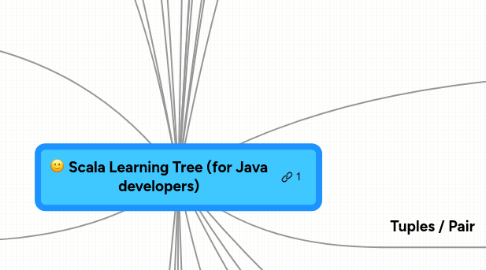
1. Variance in generics
1.1. Declaration vs Use-Site
1.1.1. ±notation
1.2. Co/Con/In-variance
2. vals/vars
2.1. 'name:Type' instead of 'Type name'
2.2. equivalent to Java's final
2.3. immutability encouraged by default
3. To Be Organised
4. Scope
4.1. private[this]
4.2. private[package]
4.3. private[<whatever>]
5. notes on this map
5.1. Try not to mention any feature unless it's defined in terms of stuff above it on the list
5.1.1. Unless under 'To Be Organised', where anything goes!
6. Oddities and FAQs
6.1. null vs Option[]
6.2. null/None/Nothing/Nil
6.3. Tooling support
6.3.1. Build systems
6.3.2. IDEs
6.3.3. Code Coverage
7. Specialist Topics
7.1. Testing
7.1.1. Specs
7.1.2. ScalaTest
7.1.3. SUnit
7.2. Java Interop
7.2.1. Collections
7.2.2. Array and GenericArray
7.2.3. Generics (erasure)
7.3. Concurrency
7.3.1. threads
7.3.2. Actors
7.3.2.1. react/reply
7.3.2.2. reactors
7.3.2.3. lift/akka/scalaz
7.3.3. fork/join
7.4. 3rd Party Libs
7.4.1. scaladb
7.4.2. scalaz
7.4.3. scalax
7.4.4. akka
7.4.5. liftweb
8. Advanced Functions
8.1. higher-typed functions
8.1.1. call by name
8.2. PartialFunction
8.2.1. From a match block
8.2.2. isDefinedAt
8.3. closures
9. New node
10. Reflection
10.1. classOf[]
10.2. Manifest and ClassManifest
10.2.1. Passed with a Context Bound
10.3. instanceof
11. Implicits
11.1. Conversions
11.1.1. View Bounds
11.1.2. Pimp-My-Library
11.2. Parameters
11.2.1. Final Parameter List may be implicit
11.2.2. e.g Ordering[T] passed to sort method
11.2.3. Context Bounds as syntaactic sugar: foo[T: Ordered](a: Any) === foo[T](a: Any)(implicit ev1$: Ordered[T])
11.2.4. Poor Mans Typeclasses: http://lampwww.epfl.ch/~odersky/talks/wg2.8-boston06.pdf
11.3. Implicit Scope
11.3.1. Local members (vals/vars/object/defs) and Imported members
11.3.1.1. (Shadowed by name!)
11.3.2. Companion object of parts of expected type
12. Collections
12.1. Mutable vs Immutable
12.2. Seq vs List vs Iterable vs Traversable
12.3. Maps
12.3.1. A map is a function
12.4. Lists
12.4.1. cons
12.4.2. head
12.4.3. tail
12.4.4. Nil
13. Tuples / Pair
13.1. a -> b syntactic sugar
13.2. (a,b) syntactic sugar
14. Basic Generics
14.1. [] notation
15. Exception Handling
16. packages and imports
16.1. _ instead of *
16.2. import anywhere
16.3. multiple package statements and resolution
16.4. import from an instance
17. First-Class Functions
17.1. apply()
17.2. passing as an argument
17.2.1. higher-typed
17.3. functions vs methods
17.4. anonymous functions
17.4.1. underscore (_) as a placeholder
17.5. Partial Application
17.6. Currying
17.7. Singleton as a Function
17.7.1. Using apply on a companion object - factory pattern
17.8. Anonymous => syntactic sugar
18. Objects and Friends
18.1. classes
18.1.1. Body is the primary constructor
18.1.2. Secondary constructors
18.1.3. val & var on params
18.2. Singletons
18.3. Companions
18.3.1. Singleton is provided via companion object
18.4. Traits
18.4.1. mixins
18.5. Case Class Basics
18.5.1. hashcode/equals/canEqual
18.5.2. args as vals
18.5.3. Constructing without 'new'
18.5.3.1. Postpone explanation of how this is achieved
18.5.4. toString
18.5.5. Postpone usage in pattern matching until pattern matching is introduced
18.6. Package Objects
19. Methods (defs)
19.1. Don't *require* parenthesis
19.2. multiple argument lists
19.3. Unit instead of void
19.3.1. '()' syntactic sugar
19.4. ': Unit' vs. not using '='
19.5. If single statement, don't require { braces }
19.6. Named arguments
19.7. Default arguments
19.8. Varargs and the _* notation
19.9. override is a required keyword, not an annotation
19.10. Exception checking is not forced
19.10.1. the @throws annotation
19.11. 'Nothing' subclasses everything
19.12. Nested/inner methods
20. Uniform Access Principle
20.1. How getters/setters work
20.2. Overriding defs with vals/vars
20.3. @BeanPropery and @BeanInfo
21. Type Basics
21.1. Inference
21.1.1. With recursive functions
21.2. Type Ascription
21.2.1. e.g. val b = 2 : Byte
21.3. Any/AnyRef/AnyVal vs Object
22. Patterns
22.1. binding
22.2. simple usage - assigning a tuple to 2 vals
22.3. match blocks
22.4. Matching on Structure
22.5. Matching on Type
22.6. Matching on absolutes
22.6.1. catch-all with an undescore
22.7. and case classes
22.7.1. sealed cases and exhaustive matches
22.8. Use in for comprehension
22.9. Extractors
22.9.1. unapply
22.9.2. unapplySeq