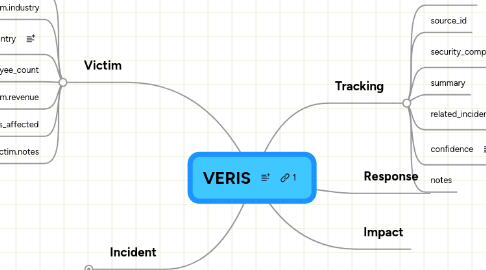
VerIS Incident Classification

The Verizon Incident Sharing framework (VerIS) is a set of metrics designed to provide a common language for describing security incidents in a structured and repeatable manner. It is the tool used by Verizon's IR team to collect data presented in the Data Breach Investigations Reports. VerIS is now available to anyone wishing to collect and compare incident information for the purposes of better decision-making. The framework has 4 main sections: Demographics, Incident Classification, Discovery and Mitigation, and Impact Classification. The Incident Classification piece makes for a particularly interesting mindmap (thus why we put it here). This section translates the incident narrative of “who did what to what (or whom) with what result” into a form more suitable for trending and analysis. To accomplish this, VerIS employs the A4 Threat Model developed by Verizon’s Risk Intelligence team. In the A4 model, a threat scenario or actual security incident is viewed as a series of events that adversely affects the information assets of an organization. Every event is comprised of the following elements (the 4 A’s), which provide the top-level structure for metrics in this section. Agent: Whose actions affected the asset Action: What actions affected the asset Asset: Which assets were affected Attribute: How the asset was affected Describing the incident is a process of classifying all elements (and sub-elements) for all significant events. Hope you find the mind map interesting.

Asset

Servers and Applications

Authentication server

Backup server

Chat/IM server

Data warehouse

Database server

DHCP server

Directory server

Distributed Control System

DNS server

Fax server

File server

FTP server

IDS/IPS server

Log server

Mail server

Mainframe

Media server

Middleware

Payment switch/gateway

POS server

Print server

Proxy server

Remote Access server

SCADA system

Software distribution server

Terminal services server

Web app/server

Networks and NW Devices

Private Branch Exchange (PBX)

Demarcation point/device

Wiring closet

LAN cabling/jack

Telephone network/line

Storage Area Network (SAN)

Wireless LAN

Private WAN link/line

Public WAN link/line

Mobile broadband network

Modem bank

Wireless Access Point

VoIP appliance

Router

Switch

Firewall

Hardware security module (HSM)

IDS/IPS sensor

Remote Terminal Unit (RTU)

Programmable Logic Controller (PLC)

Camera/video device

Physical security system

End-User Devices

Desktop / Workstation

Laptop / Netbook / Tablet

Uncontrolled computer (non-corporate)

Media player / recorder

Mobile phone (includes smartphones/PDAs)

Uncontrolled computer

POS terminal

Self-service kiosk

Automated Teller Machine (ATM)

Pay at the Pump terminal

PIN entry device/Card reader (portable/detached)

Telephone

VoIP phone

Printer/copier/scanner/fax

Authentication token/device

Offline Data

Backup tapes

Disk media

Documents

Exported data (i.e., data taken and stored locally)

Flash drive/cards

Hard disk drive

Payment card

Smart card / chip card

People

Executive/Upper Management

Auditor

System/network administrator

Software developer

Maintenance staff

Janitorial staff

Security Staff

Human resources staff

Helpdesk staff

Finance/Accounting staff

Regular employee/end-user

Partner (B2B)

Customer (B2C)

Attribute

Confidentiality

Possession or Control

Integrity

Authenticity

Availability

Utility

Agent

External

Activist group

Another organization (not partner or competitor)

Auditor

Competitor

Customer (B2C)

External system(s) or site

Force majeure (nature & chance)

Former employee

Government

Maintenance/Construction crew

Organized criminal group

Relative or acquaintance or employee

Terrorist group

Unaffiliated person(s)

Internal

Auditor

Regular employee / end-user

Executive / Upper Management

Finance / Accounting staff

Helpdesk staff

Human resources staff

Internal system or site

System / network administrator

Janitorial staff

Maintenance staff

Security guard

Software developer

Partner

Auditor

Data Processing and Analysis

Data storage / archiving

Hardware vendor

Hosting provider

Information/Content provider

Janitorial services

Onsite IT management/support

Security guard services

Remote IT management/support

Shipping/logistics provider

Software as a Service provider

Software developer/vendor

Storage provider

Telecommunications provider

Action

Malware

Type, Adware, Backdoor, Brute-force or dictionary attack, Capture data from an application / system process, Capture data resident on system, Keylogger / Spyware, Packet sniffer, RAM scraper, Command and Control, Destroy or corrupt data resident on system, Dialer, Disable or interfere with security controls, DoS attack on other systems, DoS attack on local system, Encrypt or sieze data resident on system, Infect other systems via email propagation (email worm), Infect other systems via network propagation (nw worm), Infect removable media or devices, Initiate client-side attack, Download / install additional malware or updates, Redirect to another site / address, Scan or footprint network, Send data to external site / entity, Send spam, System / network utilities (PsTools, Netcat)

Path, Coded into existing program / script, Email, Installed by other malware, Installed / injected by remote attacker, Instant Messaging, Network propagation, P2P / File sharing, Portable media and devices, Web/Internet (auto-executed/"drive-by" infection), Web/Internet (user-executed or downloaded)

Hacking

Type, Authentication Attacks, Brute Force and dictionary attacks, Exploitation of default or guessable credentials, Exploitation of insufficient authentication, Use of stolen login credentials, Authorization Attacks, Credential / Session Prediection, Cross-site Request Forgery, Exploitation of insufficient authorization (weak or misconfigured access control), Session Fixation, Session Replay, Command Execution / Injection Attacks, Buffer overflow, Format String, Integer Overflows, LDAP Injection, Mail Command Injection, Null Byte Injection, OS Commanding, Remote File Inclusion, Special Element Injection, SQL Injection, SSI Injection, XML Injection, XPath Injection, XQuery Injection, Abuse of Functionality Attacks, Abuse of Functionality, Cache Poisoning, Resources Location Attacks, Forced browsing (aka Predictable Resource Location), Path Traversal, Denial of Service Attacks, DoS at the application layer, DoS at the network layer, XML Attribute Blowup, XML Entity Expansion, Client-side Attacks, Cross-site Scripting, Man-in-the-middle Attack, Routing Detour, Encryption Attacks, Cryptanalysis, Encryption Brute Forcing, Protocol Manipulation Attacks, Cross Site Tracing, HTTP Request Smuggling, HTTP Request Splitting, HTTP Response Smuggling, HTTP Response Splitting, XML External Entities, Miscellaneous Attacks, Exploitation of backdoor or command/control channel, Footprinting and Fingerprinting, Fuzz testing, Reverse Engineering, SOAP Array Abuse

Path, Backdoor or control channel, Network file / resource sharing service, Physical access or connection, Remote access and control services/software, Web application, Wireless network

Social

Type, Baiting (planting of physical bait), Solicitation / Bribery, Propaganda / Disinformation, Elicitation, Extortion / Blackmail, Hoax / Scam, Phishing (or any type of *ishing), Pretexting, Repudiation, Spam, Spoofing / Forgery, Influence tactics

Path, Customer (B2C), Documents, Email, In-person, Instant messaging, Partner (B2B), Peer to Peer network, Phone, Portable media, SMS / Texting, Social Networking site, Software, Web/Internet

Misuse

Type, Abuse of private knowledge, Abuse of system access / privileges, Embezzlement, skimming, and related fraud, Handling of data in an unapproved format, Handling of data on unapproved media / devices, Storage/transfer of unapproved content, Unapproved changes and workarounds, Use of unapproved hardware/devices, Use of unapproved software/services, Violation of asset/data disposal policy, Violation of data retention policy, Violation of email/IM use policy, Violation of web/Internet use policy

Physical

Type, Arson, Assault and Battery, Local access (i.e. Keyboard, network jack, etc), Passive interception, Sabotage, Snooping, Surveillance, Tampering, Theft, Wiretapping

Path, External location - Public area or building, External location - Public vehicle, External location - Hotel room, External location - Private area or building, External location - Private vehicle, Victim location - Outdoor area, Victim location - Disposal area, Victim location - Indoor public/customer area, Victim location - Indoor non-public area, Victim location - Indoor high security area

Error

Type, Capacity overload, Classification or labeling error, Data entry error, Disposal error, Maintenance error (ie, during hardware upgrade), Gaffe (inadvertent disclosure, "let something slip"), General user error, Loss or misplacement, Misconfiguration, Misaddress or misdelivery (ie, mail sent to wrong recipient), Misinformation (accidentally giving false info), Omission (something overlooked or left undone), Physical accidents (ie, bankhoe power cable), Programming error, Publishing error (ie, posting private info on public site), Technical / System malfunction, Trips and spills

Path, Insufficient technology resources, Insufficient personnel resources, Inadequate processes, Lack of knowledge/skill, Carelessness, Random act

Environmental

Type, Infrastructure Hazards, Electromagnetic interference (including RFI), Electrical/chemical fire, Static electricity/ESD, Power failures and fluctuations, Water leaks and discharges, Natural Hazards, Deterioration and degradation, Dust and dirt, Earthquake, Extreme temperatures, Fire, Flood, Hazardous materials, Humidity, Hurricane, Landslide, Lightning, Meteorites and astreroids, Pathogen, Snow and Ice, Tornado, Tsunamis, Volcanic eruption, Vermin, Wind, Hazardous materials