

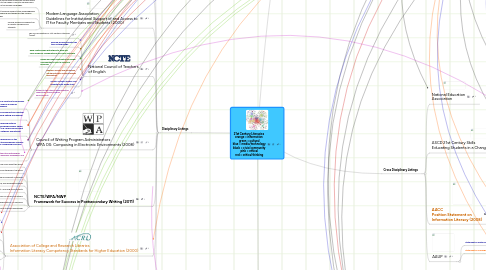
1. Disciplinary Listings
1.1. National Council for Geographic Education (2009)
1.2. National Science Teacher's Association (2011)
1.3. Modern Language Association Guidelines for Institutional Support of and Access to IT for Faculty Members and Students (2000)
1.3.1. Provide an information technology infrastructure adequate to the needs of faculty members and students in the modern languages.
1.3.2. Appoint technical support staff knowledgeable about research and teaching in the modern languages.
1.3.3. Provide access and support for all faculty members and students.
1.4. National Council of Teachers of English
1.4.1. The NCTE Definition of 21st Century Literacies (2008)
1.4.2. Develop proficiency with the tools of technology
1.4.3. Build relationships with others to pose and solve problems collaboratively and cross-culturally
1.4.4. Design and share information for global communities to meet a variety of purposes
1.4.5. Manage, analyze and synthesize multiple streams of simultaneous information
1.4.6. Create, critique, analyze, and evaluate multi-media texts
1.4.7. Attend to the ethical responsibilities required by these complex environments
1.5. Council of Writing Program Administrators WPA OS: Composing in Electronic Environments (2008)
1.5.1. Use a variety of technologies to address a range of audiences
1.5.2. Use electronic environments for drafting, reviewing, revising, editing, and sharing texts
1.5.3. Locate, evaluate, organize, and use research material collected from electronic sources, including scholarly library databases; other official databases (e.g., federal government databases); and informal electronic networks and internet sources
1.5.4. Understand and exploit the differences in the rhetorical strategies and in the affordances available for both print and electronic composing processes and texts
1.5.5. Understand the relationships among language, knowledge, and power
1.6. NCTE/WPA/NWP Framework for Success in Postsecondary Writing (2011)
1.6.1. Curiosity – the desire to know more about the world.
1.6.2. Openness – the willingness to consider new ways of being and thinking in the world.
1.6.3. Engagement – a sense of investment and involvement in learning.
1.6.4. Creativity – the ability to use novel approaches for generating, investigating, and representing ideas.
1.6.5. Persistence – the ability to sustain interest in and attention to short- and long-term projects.
1.6.6. Responsibility – the ability to take ownership of one’s actions and understand the consequences of those actions for oneself and others.
1.6.7. Flexibility – the ability to adapt to situations, expectations, or demands.
1.6.8. Metacognition – the ability to reflect on one’s own thinking as well as on the individual and cultural processes used to structure knowledge.
1.7. Association of College and Research Libraries Information Literacy Competency Standards for Higher Education (2000)
1.7.1. Determine the extent of information needed
1.7.2. Access the needed information effectively and efficiently
1.7.3. Evaluate information and its sources critically
1.7.4. Incorporate selected information into one’s knowledge base
1.7.5. Use information effectively to accomplish a specific purpose
1.7.6. Understand the economic, legal, and social issues surrounding the use of information, and access and use information ethically and legally
1.8. National Council for the Social Studies Media Literacy (2009)
1.8.1. What social, cultural, historical, and political contexts are shaping the message and the meaning I am making of it?
1.8.2. How and why was the message constructed?
1.8.3. How could different people understand this information differently?
1.8.4. Whose perspective, values and ideology are represented and whose are missing?
1.8.5. Who or what group benefits and/or is hurt by this message?
2. Corporate Listings
2.1. 21st Century Literacies (2002)
2.1.1. information
2.1.2. cultural
2.1.3. visual
2.1.4. media
2.2. Partnership for 21st Century Skills Framework for 21st Century Learning (2002)
2.2.1. Core Subjects and 21st Century Themes
2.2.1.1. Disciplines
2.2.1.2. Global awareness
2.2.1.3. Financial, economic, business and entrepreneurial literacy
2.2.1.4. Civic literacy
2.2.1.5. Health literacy
2.2.1.6. Environmental literacy
2.2.2. Learning and Innovation Skills
2.2.2.1. Creativity and Innovation
2.2.2.2. Critical Thinking and Problem Solving
2.2.2.3. Communication and Collaboration
2.2.3. Information, Media and Technology Skills
2.2.3.1. Information Literacy
2.2.3.2. Media Literacy
2.2.3.3. Information and Communication Technologies (ICT) Literacy
2.2.4. Life and Career Skills
2.2.4.1. Flexibility and adaptability
2.2.4.2. Initiative and self-direction
2.2.4.3. Social and cross-cultural skills
2.2.4.4. Productivity and accountability
2.2.4.5. Leadership and responsibility
2.3. Intel
2.3.1. Describe with Technology
2.3.2. Explain with Technology
2.3.3. Persuade with Technology
3. Cross Disciplinary Listings
3.1. National Education Association
3.2. ASCD 21st Century Skills Educating Students in a Changing World (2008)
3.2.1. Acquire and apply core knowledge and critical-thinking skill sets that are essential in an information age.
3.2.2. Demonstrate creativity, innovation, and flexibility when partnering with business and community members to advance common goals.
3.2.3. Make decisions and solve problems ethically and collaboratively.
3.2.4. Use technology to gather, analyze, and synthesize information for application in a global economy.
3.2.5. Exhibit positive interpersonal relationships that value multiple languages, cultures, and all persons.
3.2.6. Display leadership skills that inspire others to achieve, serve, and work together.
3.3. AACC Position Statement on Information Literacy (2008)
3.3.1. Determine the extent of information needed
3.3.2. Access needed information effectively and efficiently
3.3.3. Evaluate information and its sources critically
3.3.4. Incorporate selected information into their own knowledge base
3.3.5. Use information effectively to accomplish a specific purpose
3.3.6. Understand the economic, legal, and social issues surrounding the use of information
3.3.7. Access and use information ethically.
3.4. AAUP
3.4.1. Statement on Distance Education
3.4.2. Statement on Copyright
4. Other Literature
4.1. DIY U (2010)
4.1.1. Metacognition or thinking about thinking
4.1.2. How to write a budget and manage money
4.1.3. How to improve your relationships
4.1.4. Physical fitness and health
4.1.5. How to understand and interact with digital technologies
4.2. Jenkins et. al Confronting the Challenges of Participatory Culture: Media Education for the 21st Century (2009)
4.2.1. Play — the capacity to experiment with one’s surroundings as a form of problem-solving
4.2.2. Performance — the ability to adopt alternative identities for the purpose of improvisation and discovery
4.2.3. Simulation — the ability to interpret and construct dynamic models of real-world processes
4.2.4. Appropriation — the ability to meaningfully sample and remix media content
4.2.5. Multitasking — the ability to scan one’s environment and shift focus as needed to salient details.
4.2.6. Distributed Cognition — the ability to interact meaningfully with tools that expand mental capacities
4.2.7. Collective Intelligence — the ability to pool knowledge and compare notes with others toward a common goal
4.2.8. Judgment — the ability to evaluate the reliability and credibility of different information sources
4.2.9. Transmedia Navigation — the ability to follow the flow of stories and information across multiple modalities
4.2.10. Networking — the ability to search for, synthesize, and disseminate information
4.2.11. Negotiation — the ability to travel across diverse communities, discerning and respecting multiple perspectives, and grasping and following alternative norms.