

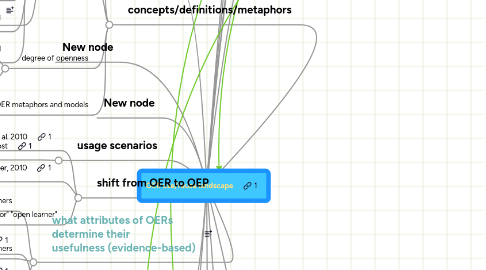
1. concepts/definitions/metaphors
1.1. OER as supply-driven concept
1.1.1. Wiley blogpost
1.2. reusibility
1.2.1. Windle et al. 2010
1.2.2. Wiley 2009
1.2.3. Boyle&Cook 2003, Learning Objects, Pedagogy and Reuse
1.3. degree of openness
1.3.1. OER = 4R
1.3.1.1. Wiley blogpost
1.3.2. is use good enough?
1.3.2.1. Amber Thomas blogpost
1.4. OER metaphors and models
1.4.1. Robertson blogpost
2. signs of models of engagement
2.1. CoP
2.1.1. OpenLearn: LearningSpace and LabSpace model
2.1.1.1. McAndrew 2009
2.1.2. development and reuse teams
2.1.2.1. Windle et al. 2010
2.2. OER fully integrated into staff development programme
2.2.1. Browne 2010
2.3. awarness workshops
2.3.1. Browne 2010
2.3.2. Beggan, presentation at ALT-C 2010
2.4. toolkits on reuse
2.4.1. University of Nottingham, Interactive toolkit
3. perceived benefits & barriers/attitudes
3.1. to academics
3.1.1. Brown 2010
3.1.2. Beggan 2009
3.2. to learners
3.2.1. Witthaus&Armellini, 2010, OTTER project final report
3.3. McGill, Beetham, Falconer, Littlejohn, 2010
3.4. Wiley 2009
3.5. D'Antoni 2009
4. reuse case studies
4.1. Windle et al 2010
4.2. Greaves et al 2010
5. learning design as pedagogic undepinning for OERs
5.1. Browne 2010
5.2. Conole & Weller 2008
5.3. Boyle&Cook 2004, Learning Objects, Pedagogy and Reuse
5.4. Conole blogpost
5.5. Kahle 2008
5.6. Gurell, Kuo, Walker 2010
6. shift from OER to OEP
6.1. Conole et al. 2010
6.2. OPAL positioning paper, 2010
6.3. "open educator" "open learner"
6.3.1. Leslie wiki-entry
6.3.2. Leslie comment to Robertson blogpost
7. voices advocating for shift from supply-side to demand-side
7.1. Browne 2010
7.2. Beggan 2009
7.3. Harley, 2008
7.4. McAndrew&Cropper 2010, OLnet project
7.5. hai
8. evidenced use&reuse/benefits
8.1. educators/teachers
8.1.1. Gourley&Lane 2009
8.2. learners
8.2.1. Gourley&Lane 2009
8.2.2. Wilson et al. 2010, Listening for Impact project
8.3. Windle et al. 2010
8.4. McGill, Beetham, Falconer, Littlejohn, 2010
8.5. Johansen 2009
9. what attributes of OERs determine their usefulness (evidence-based)
9.1. for teachers
9.1.1. Greaves et al. 2010 (RLOs)
9.1.2. Windle et al. 2010 (RLOs +)
9.2. for learners
9.2.1. Lane 2008 (self-study modules)
9.3. McGill, Beetham, Falconer, Littlejohn, 2010
10. usage scenarios
10.1. Conole blogpost
11. New node
12. New node
13. areas definded as challenging
13.1. issues relating to quality assurance and trust
13.1.1. at the point of release
13.1.1.1. Windle et al 2010
13.1.2. at the point of reuse
13.1.2.1. Wiley & Gurrell 2009
13.1.3. big and little OER debate
13.1.4. models for OER QA
13.1.4.1. Philip et al 2008
13.1.5. through repositories or institutional websites
13.1.5.1. Greaves et al 2010
13.1.6. distributed (user communities) vs. central (faculties)
13.1.6.1. pros and cons of both models are discussed by Harley 2008
13.2. lack of skills to repurpose materials
13.2.1. Beggan 2009
13.2.2. Conole & Weller 2008
13.3. teaching culture
13.3.1. what is common practice in research (referencing) has no established tradition in teaching & learning
13.3.1.1. Beggan 2009
13.3.2. lack of tradition of transparency in t&l reinforced by the introduction of VLEs
13.3.2.1. McGill et al. 2008
13.4. conflicting agendas: research vs. teaching excellence
13.4.1. Browne 2010
14. what's new? debate
14.1. Wiley, OER 101 Theory and Practice
14.2. Greaves et al 2010
14.3. OECD 2007
14.4. Windle et al. 2010
14.5. Wiley, The OER Meal Deal
14.6. Robertson blogpost
14.7. Levine, comment to Robertson blogpost
15. OER types and development models
15.1. little OER
15.1.1. teacher sharing what they're doing
15.1.1.1. Weller blogpost
15.1.1.2. Robertson blogpost
15.1.1.3. Amber Thomas post
15.2. big oer
15.2.1. MIT-like
15.2.1.1. shared as it is
15.2.1.1.1. Gourley&Lane 2009
15.2.2. as it is + textual description of context of use
15.2.2.1. Beggan 2009
15.2.3. OpenLearn model: OERs developed using existing pedagogical model for designing self-study materials for online learning but with adaptations that make them act more as Learning Objects
15.2.3.1. Lane 2008
15.2.3.2. McAndrew 2009
15.2.3.3. Gourley & Lane 2009
15.2.4. RLOs +
15.2.4.1. designed for reuse
15.2.4.1.1. example: GLOs reused by Greaves et al 2010
15.2.5. design focuses on primary use but intention to support reuse is part of the approach
15.2.5.1. Windle et al 2010
15.2.6. designing OERs from scratch
15.2.6.1. Browne 2010
15.3. OECD 2007 after Margulies, 2005
15.3.1. Conole&Weller 2008
16. what is common for sharing & reuse?
16.1. who shares is more likely to reuse and vice versa
16.1.1. Windle et al., 2010 after Windle et al. 2007
16.1.2. does not apply to research-led universities?
16.1.2.1. Harley 2008 after Harley et al. 2007 (evidence from the University of California, US)
16.2. academics care about demand-side and want to be provided with evidence of use and value to end-user
16.2.1. Browne 2010
16.2.2. Beggan 2009
16.3. quality assurance and trust are both major issues to sharing and reuse, only the angle of looking at them is different
16.3.1. Begann 2009,
16.3.2. Windle et al. 2010
16.3.3. Browne 2010
16.4. Bringing reuse closer to sharing with help of Web2.0
16.4.1. Beggan 2009
16.4.2. Gourley and Lane 2009, OpenLearn example
17. Implications for our study
17.1. specific mentality that goes with openness?
17.2. what do we already know about the reuse of RLOs that can be relevant for RLOs +
17.2.1. Include in the interviews and workshops those who have experience in reusing RLOs