

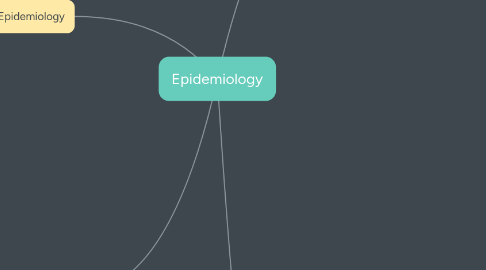
1. Clinical Epidemiology
1.1. Secondary Prevention
1.1.1. Screening
1.1.1.1. validity
1.1.1.2. reliability
1.1.1.3. yield
1.1.1.4. sensitivity
1.1.1.5. specificity
1.1.1.6. predictive values
1.1.1.6.1. positive
1.1.1.6.2. negative
1.2. Health status measures
1.2.1. Diagnostic testing
1.2.1.1. prognosis
1.2.1.1.1. survival rate
1.2.1.1.2. survival time
1.2.1.1.3. case fatality rate
1.2.1.1.4. measures can find the
1.2.1.2. diagnosis
2. History
2.1. John Snow
2.1.1. Broad street pump
2.1.2. Mapping
2.1.3. Contagionists
3. Analytical Epidemiology
3.1. Why, How?
3.2. strategies and methods
3.2.1. measurements
3.2.1.1. ratio
3.2.1.1.1. risk
3.2.1.1.2. rate
3.2.1.1.3. odds
3.2.1.2. proportion
3.2.1.3. rate
3.2.1.3.1. crude
3.2.1.3.2. age-adjusted
3.2.1.3.3. standardized morbidity
3.2.1.4. confidence intervals
3.2.1.4.1. must take into account
3.2.2. must be found
3.2.2.1. Cause
3.2.2.1.1. Etiology
3.2.2.1.2. Bradford hill
3.2.2.2. Sufficient cause
3.2.2.2.1. can use
3.2.2.2.2. must account for
3.2.3. steps
3.2.3.1. Hypothesis
3.2.3.1.1. hypothesis testing
3.2.4. May be alerted by
3.2.4.1. incidence
3.2.4.1.1. must find the
3.2.4.2. prevalence
3.3. studies
3.3.1. Cross section
3.3.2. Case Report
3.3.3. Case Series
3.3.4. specific examples of studies
3.3.4.1. Framingham Heart study
3.3.4.1.1. cohort study
3.3.4.1.2. smoking and health
3.3.5. Prospective
3.3.6. Intervention
3.3.6.1. controlled trials
3.3.6.1.1. analyzes the individual
3.3.6.1.2. done in a clinical setting
3.3.6.2. Community trials
3.3.6.2.1. groups or communities
3.3.6.2.2. only one group receives intervention
3.3.7. Natural experiment
3.3.7.1. occurs unplanned
3.3.8. experimental
3.3.8.1. uses
3.3.8.1.1. Between group design
3.3.8.1.2. Within group design
3.3.8.1.3. Random assignment
3.3.8.1.4. Non random
4. Descriptive Epidemiology
4.1. Surveillance
4.1.1. Epidemic
4.1.2. Outbreak
4.1.2.1. cluster
4.1.3. Endemics
4.1.4. Pandemics
4.1.5. Data
4.1.5.1. Information
4.1.5.1.1. Message
4.2. Trends
4.2.1. Pyramids
4.2.1.1. Expanding
4.2.1.2. Stationary
4.2.1.3. constrictive
4.2.2. Secular
4.2.3. Short term
4.2.4. cyclical
4.3. Who, What, When, Where?
4.3.1. Preventions
4.3.1.1. Primary
4.3.1.2. Secondary
4.3.1.3. Tertiary
4.3.2. Diagnosis, cause, treatment, prognosis
5. Transmission
5.1. Spread
5.1.1. Vector
5.1.2. Host
5.1.3. Reservoir
5.1.4. Fomite
5.2. prevention
5.2.1. Heard Immunity
5.2.1.1. vaccination
5.2.1.2. active immunity
5.2.1.3. passive immunity
5.2.2. quarantine
5.2.3. Isolation
5.3. sources and modes of transmission
5.3.1. infectious agents
5.3.1.1. airborn
5.3.1.2. vector-borne
5.3.1.3. vehicle-borne
5.3.1.4. biological
5.3.1.5. mechanical
5.3.2. risk factors
5.3.2.1. lifestyle
5.3.2.2. environmental stress
6. Disease
6.1. Chronic
6.1.1. Disability
6.1.2. long term
6.2. Acute
6.2.1. short term