

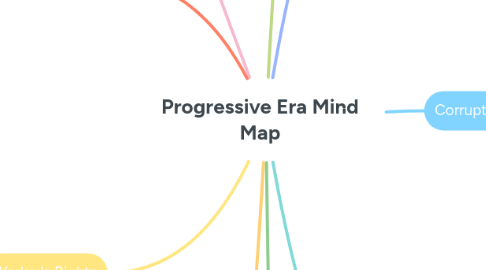
1. Racism
1.1. Reformers
1.1.1. Ida B. Wells
1.1.1.1. W.E.B Dubois
1.1.1.1.1. Booker T. Washington
1.2. Solutions
1.2.1. Ida escaped the South and then became a journalist who wrote to fight against lynching. She wrote specifically against black lynching and violence against black people that she and others had faced.
1.2.1.1. W.E.B helped make an organization called the N-A-A-C-P. (National Association for the Advancement of Colored People). This organization is still helping to end discrimination.
1.2.1.1.1. Booker wanted to achieve equality so he ended up creating a school called the Tuskegee Institute. This was a school for African Americans to achieve their own success.
1.3. Problem
1.3.1. After the Reconstruction Era, the South starting limiting the rights of Black Americans. They were very violent towards African Americans and even made them take tests to vote.
2. Health and Safety
2.1. Reformers
2.1.1. Upton Sinclair
2.1.1.1. Alice Hamilton
2.1.1.1.1. Lillian Wald
2.2. Solutions
2.2.1. Upton wrote a novel that exposed the dangerous conditions of the meat packing plant. This novel inspired Roosevelt to create an organization to inspect companies and fix the safety issues.
2.2.1.1. Alice was a doctor who taught factory owners how to make factories safer so workers wouldn't die or be injured from lead poisoning.
2.2.1.1.1. Lillian was a nurse who started a Nurse Visiting Program so nurses could visit patients at their homes. She also created the idea of school nurses.
2.3. Problem
2.3.1. There was no way to tell if food was contaminated which caused lots of sickness.
3. Conservation
3.1. Reformers
3.1.1. Theodore Roosevelt
3.2. Solution
3.2.1. Teddy Roosevelt pushed for federal laws to make businesses and companies for the amount of natural resources they can use. He also doubled the amount of National parks across the nation.
3.3. Problem
3.3.1. People were using too many natural resources which would've caused the amount of natural resources to decrease rapidly.
4. Worker's Rights
4.1. Reformers
4.1.1. Samuel Gompers
4.1.1.1. AFL
4.2. Solutions
4.2.1. Samuel was a child factory worker who became the leader as he grew up and fought for laws to be put in place to improve work conditions.
4.2.1.1. The American Federation of Labor was help started by Gompers and some other people. Many other Unions eventually joined creating better working conditions for all workers.
4.3. Problem
4.3.1. Low wages
4.3.1.1. Long work days
5. Poverty
5.1. Reformers
5.1.1. Jacob A. Riis
5.1.1.1. Jane Addams
5.2. Solutions
5.2.1. Jacob took photos of the slums and inspired others to improve the conditions of them.
5.2.1.1. Jane had brought a house and transformed it into a place that the poor people could stay.
5.3. Problem
5.3.1. Immigrants came to America and made towns over-populated. Many families could not afford homes. They usually settled in urban slums.
6. Corruption
6.1. Reformers
6.1.1. William S. U'ren
6.1.1.1. Robert M-La Follette
6.2. Solution
6.2.1. William promoted 3 different government reforms: 1: Allows voters to propose laws 2: Allows citizens to vote on proposed laws 3: Allows people to vote out government officials
6.2.1.1. Robert M-La Follette promoted Direct Primary which allows voters to choose candidates for the parties to run in elections.
6.3. Problem
6.3.1. Large businesses were growing even larger. The locals and federal government were becoming more and more corrupt. They did this by wanting more power and being fraudulent with the business officials.
7. Child Labor
7.1. Reformers
7.1.1. Lewis Hine
7.1.1.1. National Child Labor Committee (NCLC)
7.2. Solution
7.2.1. Lewis took photos of the terrible working conditions in child labor factories to show America what the working conditions were really like.
7.2.1.1. The NCLC was a committee that got support for child labor laws and laws that require children to attend school instead of having children in dangerous working conditions
7.3. Problem
7.3.1. Children were working in dangerous working conditions for hours on end. They were also being paid very little money but needed to work because their families were poor.
8. Prohibitation
8.1. Reformers
8.1.1. Mary Hunt
8.1.1.1. Carrie Nation
8.1.1.1.1. 18th Amendment
8.2. Solution
8.2.1. All three of the reformers worked toward the idea of banning alcohol to protect people's health and society as a whole. They all had the idea that alcohol was the path to insanity and was no good to have in America.
8.3. Problems
8.3.1. The idea of alcohol was believed to be connected to signs of insanity, violence, and even poverty. It was labeled as dangerous and the idea of banning the product lingered in the air.
8.4. Unintended Consequences
8.4.1. Bootleggers
8.4.1.1. Speakeasies
8.4.1.1.1. Organized Crime
8.5. Solution
8.5.1. As the 18th amendment was passed, many people got upset. Illegal nightclubs known as speakeasies began. Bootleggers made lots of money by illegally transporting alcohol and selling it. Organized crime rates going up showed that this ban wasn't the best thing to do and appealed the decision by the 21st amendment.
9. Woman Suffrage
9.1. Reformers
9.1.1. Elizabeth Cady Stanton
9.1.1.1. Susan B. Anthony
9.1.1.1.1. NAWSA
9.2. Solutions
9.2.1. Elizabeth Cady Stanton served as the first president of the NAWSA. She worked with Susan to achieve the progress of women gaining rights.
9.2.1.1. Susan B. Anthony became a president in 1892 and worked with Elizabeth. Together they brought the idea of women's voting rights and changed the idea of it.
9.3. Problem
9.3.1. Before the 1890's no women were granted the rights to vote. This became the longest fight of any other reform.