Unlock the full potential of your projects.
Try MeisterTask for free.
Don't have an account?
Sign Up for Free
Browse
Featured Maps
Categories
Project Management
Business & Goals
Human Resources
Brainstorming & Analysis
Marketing & Content
Education & Notes
Entertainment
Life
Technology
Design
Summaries
Other
Languages
English
Deutsch
Français
Español
Português
Nederlands
Dansk
Русский
日本語
Italiano
简体中文
한국어
Other
Show full map
Copy and edit map
Copy
Electromagnetic Waves
SK
Shaun Koh
Follow
Solve your problems or get new ideas with basic brainstorming
Get Started.
It's Free
Sign up with Google
or
sign up
with your email address
Similar Mind Maps
Mind Map Outline
Electromagnetic Waves
by
Shaun Koh
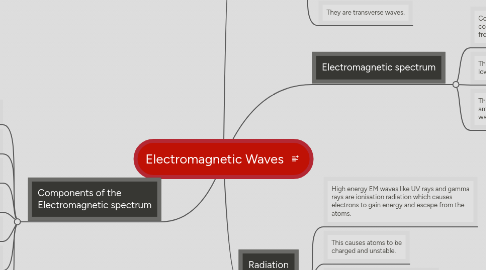
1. Components of the Electromagnetic spectrum
1.1. a) Radio waves
1.2. b) Microwaves
1.3. c) Infared(IR)
1.4. d) Visible Light
1.5. e) Ultra-violet rays (UV)
1.6. f) X-rays
1.7. g) Gamma rays
2. Properties
2.1. Does not require medium
2.2. Travel at constant speed of 3.0x10^8 m/s
2.3. Follows laws of reflection and refraction
2.4. Obey general wave equation: c=lambda/T c=f lambda
2.5. They are transverse waves.
3. Electromagnetic spectrum
3.1. Consists of EM waves of a continuous range of frequencies.
3.2. The higher the frequency, the lower the wavelength, vice versa
3.3. The higher the frequency, the greater the amount of energy carried by the EM wave.
4. Radiation
4.1. High energy EM waves like UV rays and gamma rays are ionisation radiation which causes electrons to gain energy and escape from the atoms.
4.2. This causes atoms to be charged and unstable.
4.3. Unstable atoms are likely to cause mutation in cells due to damaged DNA.
4.4. This harmful mutation leads to cancer or faulty genetic material being passed to the offspring.
Get Started. It's free!
Connect with Google
or
Sign Up