

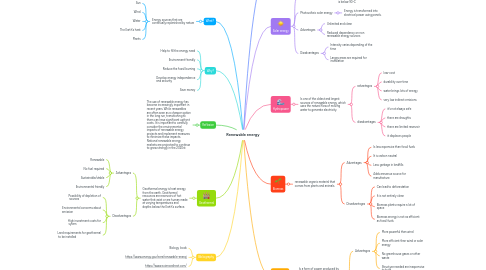
1. What?
1.1. Energy sources that are continually replenished by nature
1.1.1. Sun
1.1.2. Wind
1.1.3. Water
1.1.4. The Earth's heat
1.1.5. Plants
2. Wind energy
2.1. Turbines convert the kinetic energy from the wind into mechanical power
2.1.1. Advantages
2.1.1.1. Unlimited and free
2.1.1.2. The cost of installing is low
2.1.2. Disadvantages
2.1.2.1. Difficult to store when production excess demand
2.1.2.2. Turbines are dangerous for birds
3. Why?
3.1. Help to fill the energy need
3.2. Environment friendly
3.3. Reduce the fossil burning
3.4. Develop energy independence and security
3.5. Save money
4. Solar energy
4.1. Thermal solar energy
4.1.1. Used to heat fluid in a solar collector.Depending on tempearture High and low which is below 90ºC
4.2. Photovoltaic solar energy
4.2.1. Energy is transformed into electrical power using panels.
4.3. Advantages
4.3.1. Unlimited and clean
4.3.2. Reduced dependency on non renewable energy sources
4.4. Disadvantages
4.4.1. Intensity varies depending of the time
4.4.2. Larges areas are required for installation
5. Reflexion
5.1. The use of renewable energy has become increasingly important in recent years. While renewables are often seen as a cheaper option in the long run, transitioning to them can have significant upfront costs. It is important to carefully consider the environmental impacts of renewable energy projects and implement measures to minimize these impacts. National renewable energy markets are projected to continue to grow strongly in the 2020st
6. Hydropower
6.1. Is one of the oldest and largest sources of renewable energy, which uses the natural flow of moving water to generate electricity.
6.1.1. advantages
6.1.1.1. low-cost
6.1.1.2. durability over time
6.1.1.3. water brings lots of energy
6.1.1.4. very low indirect emisions
6.1.2. disadvantages
6.1.2.1. it's not always safe
6.1.2.2. there are droughts
6.1.2.3. there are limited reservoir
6.1.2.4. it displaces people
7. Biomass
7.1. renewable organic material that comes from plants and animals.
7.1.1. Advantages
7.1.1.1. Is less expensive than fossil fuels
7.1.1.2. It is carbon neutral
7.1.1.3. Less garbage in landfills
7.1.1.4. Adds arevenue source for manufacture
7.1.2. Disadvantages
7.1.2.1. Can lead to deforestation
7.1.2.2. It is not entirely clean
7.1.2.3. Biomass plants require a lot of space
7.1.2.4. Biomass energy is not as efficient as fossil fuels
8. Geothermal
8.1. Geothermal energy is heat energy from the earth. Geothermal resources are reservoirs of hot water that exist or are human made at varying temperatures and depths below the Earth's surface.
8.1.1. Advantages
8.1.1.1. Renewable
8.1.1.2. No fuel required
8.1.1.3. Sustainable/stable
8.1.1.4. Environmental friendly
8.1.2. Disadvantages
8.1.2.1. Possibility of depletion of sources
8.1.2.2. Environmental concerns about emission
8.1.2.3. High investment costs for sytem
8.1.2.4. Land requirements for geothermal to be installed
9. Bibliography
9.1. Biology book
9.2. https://www.energy.gov/eere/renewable-energj
9.3. https://www.sciencedirect.com/
10. Tidal Power
10.1. Is a form of power produced by the natural rise and fall of tides caused by the gravitational interaction between Earth, the sun, and the moon.
10.1.1. Advantages
10.1.1.1. More powerful than wind
10.1.1.2. More efficient than wind or solar energy
10.1.1.3. No greenhouse gases or other waste
10.1.1.4. Structure needed are inexpensive to build
10.1.2. Disadvantages
10.1.2.1. Effect on animals and plants living near tidal stations
10.1.2.2. Disturbs migration of living creatures in the ocean
10.1.2.3. Formation of silt behind the barrage
10.1.2.4. It produces power for only about 10 h of the day