

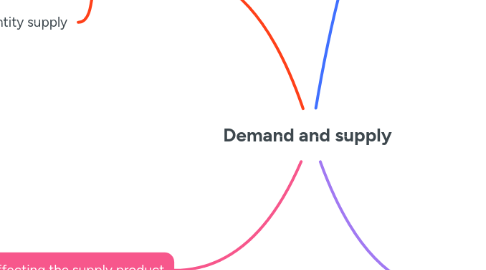
1. Supply
1.1. Theory of supply
1.1.1. Supply of a good refers to the amount of a good producers are willing and able to sell in a given period of time at a given price, ceteris paribus
1.2. The law of supply
1.2.1. The law of supply states that in a given period of time, the quantity supplied of a product is directly related to its price, ceteris paribus The higher the price of a good or a service, the more producers are willing and able to sell the goods and services
1.3. Changes in supply and quantity supply
1.3.1. Quantity supply
1.3.1.1. A change in availability of a good or service occurs due to a change in the price of the good or service itself. Diagrammatically , it is illustrated by a movement along the supply curve
1.3.2. supply
1.3.2.1. A change in availability of a good or service occurs because of factors not relating to the price of the good or service itself, it is said that there has been a change in supply
2. Factors affecting the supply product
2.1. Weather conditions
2.2. Ease of borrowing
2.2.1. Easy credit facilities such as the availability of lower interest loans and more favourable terms offered by banks makes the cost of borrowing or spending on credit more attractive
2.3. Technology
2.3.1. Technological changes take place over time as a result of innovation and interprise . Wuth improved production methods, factors of production will be more productive and hence, the production of goods would increase, thus giving rise to increase in supply, shifting the supply curve to the right.
2.4. Production of related goods
2.4.1. Conpetitive supply
2.4.1.1. A product in competitive supply is a product that uses some of the same resources as are used to produce another product. There two products are termed as competitive supply since an increased competitive supply since an increased production of one will mean diverting some resources away from producing the other.
2.4.2. Joint supply
2.4.2.1. These two goods where the production of more of one leads to the production of more of the other.
2.5. Government policy
2.5.1. The imposition of indirect taxes and granting of subsidies will bring about changes in supply. An indirect tax imposed on a good increase the cost of supplying that good.
2.5.1.1. Subsidies have the opposite effect- they lower the cost of production and supply is increased, thus shifting the supply curve to the right.
2.6. Price of factors input
2.6.1. The amount of a good or service which producers are willing and able to produce depends on the costs of factor inputs, including wages, rent, payments, fuel, int erest rates and raw material prices. An increase in factor brices will cause the costs of producing the same quantity of the good to increase, affecting profitability
2.6.1.1. The effect of this increase in the cost of production shifts the supply curve to the left.
3. Demand
3.1. Theory of demand
3.1.1. Demand is detined as the amount of goods consumers are able and willing to buv in a given period of time at a given price, ceteris paribus
3.1.2. In a given period of time, the quantity demanded of a product is inversely related to its price, ceteris parious
3.2. Law of demand
3.2.1. Consumers' obiective is to maximise satistaction per additional dollar spent on a goo or service
3.3. Changes in demand and quantity demanded
3.3.1. Quantity demanden
3.3.1.1. Change in the price of the good or service itself Diagrammatically, it is illustrated by a movement along the demand curve.
3.3.2. Demand
3.3.2.1. When the change in amount purchased because of factors not relating to the price of the good or service itself. Diagrammatically, it is represented by a shift of demand curve.
4. Factors affecting the demand for a product
4.1. Price of related goods
4.1.1. Substitudes
4.1.1.1. A substitute product is an alternative product that can replace another because it satisties the same want. A change in the price for one good causes a shift in the same direction of the demand curve for the substitute good.
4.1.2. Complements
4.1.2.1. A complement product is one which must be used at the same time with another to satisfy the same human want A change in price for one good tends to cause a shift in the opposite direction of the demand curve for the complementary good.
4.1.3. Derived demand
4.1.4. Derived demand
4.1.4.1. Goods are said to be in derived demand when a good is demanded not for its own sake but for its contribution to the manufacture of another product. It applies to the demand for eproductivee resources.
4.2. Consumer’s money income
4.2.1. Normal goods
4.2.1.1. These are goods whose demand increase with an increase in money income of consumers and vice versa. When income increase , the demand of normal goods increase
4.2.2. Inferior goods
4.2.2.1. These are goods whose demand varies inversely with consumers' money income When income increase , the demand of inferior goods increase
4.3. Taste and prefference
4.3.1. Consumer's tastes and preferences are influenced by current fashion peers, advertisements, pop-star appeal, age, gender, culture etc. Changes in consumers' tastes in favour of (or against) a good or service will increase (or decrease ) its demand as this would affect their buying patterns for the product.
4.4. Expectations of future price changes
4.4.1. The fear or expectation of a future price increase will induce consumers to buy more now so as to maximise per additional dollar spent, thus increasing demand for the good concerned. Example : upcoming festival
4.5. Availability of credit facilities and hire purchases
4.5.1. Easy credit facilities such as the availability of lower interest loans and more favourable terms offered by banks makes the cost of borrowing or spending on credit more attractive. Less stringent hire purchase terms will allow more consumers the ability to buy the products now, thereby increasing demand for goods
4.6. Changes in season
4.6.1. The demand for many goods and services such as clothing, food, water,healthcare and travel are influenced by seasonal conditions.
4.7. Changes in Government Economic policies
4.7.1. rules and regulations imposed by the government will affect the demand for goods and services
4.7.1.1. A reduction in personal income tax rates will result in greater disposable income, This will in turn increase the demand for normal goods and services For example : Anti-Smoking campaigns