


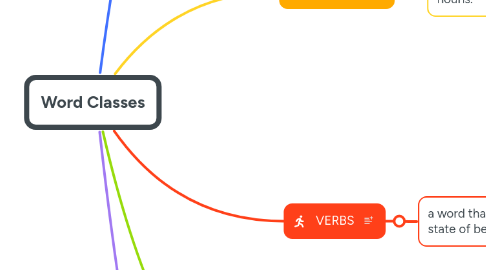
1. NOUNS
1.1. Nouns are naming words. They name people, places, things, ideas, animals,substances,etc.
1.1.1. countable nouns
1.1.1.1. things we can count.
1.1.1.1.1. bag, apple, book → two bags, three apples
1.1.2. uncountable nouns
1.1.2.1. things we cannot count directly.
1.1.2.1.1. milk, rice, water, sugar → we say a glass of milk, a kilo of rice
1.1.3. abstract nouns
1.1.3.1. ideas or feelings we cannot perceive with the five senses.
1.1.3.1.1. happiness, love, freedom, honesty
1.1.4. concrete nouns
1.1.4.1. things we can see, touch, hear, smell, or taste.
1.1.4.1.1. cellphone, dog, table
1.1.5. common
1.1.5.1. general names for people, places, or things.
1.1.5.1.1. player, city, teacher
1.1.6. proper
1.1.6.1. specific names (always capitalized).
1.1.6.1.1. James Rodríguez, Bogotá, Coca-Cola
1.1.7. collective
1.1.7.1. Words that name a group of people, animals, or things.
1.1.7.1.1. a bunch of bananas, a group of students, a class of children, a flock of birds
2. ADVERBS
2.1. adverbs are words that modify verbs and adjectives.
2.1.1. adverbs of manner
2.1.1.1. how?
2.1.1.1.1. quickly, strongly, tragically, easily, folishly
2.1.2. adverbs of time
2.1.2.1. when?
2.1.2.1.1. usually, always, occasionally, never, today, yesterday, tomorrow, afterwards.
2.1.3. adverbs of place
2.1.3.1. where?
2.1.3.1.1. above, around, away, below.
2.1.4. adverbial phrases
2.1.4.1. verb modified by more than one word.
2.1.4.1.1. "quite slowly", "very carefully", "far away", "once upon a time"
3. ADJECTIVES
3.1. adjectives are words that describe nouns.
3.1.1. descriptive
3.1.1.1. These tell us more about what something is like. They describe qualities such as size, color, age, shape, feeling, or condition.
3.1.1.1.1. Dangerous/ancient/alive/ dead
3.1.2. proper
3.1.2.1. These are made from proper nouns (names of countries, languages, or people). They usually tell us where something comes from or its style.
3.1.2.1.1. African style / Japanese car / Colombian accent/ American writter
3.1.3. possessive
3.1.3.1. These show who owns something. They always come before a noun.
3.1.3.1.1. my,your,his,her,its,our,their
4. VERBS
4.1. a word that expresses an action or state of being.
4.1.1. action verbs
4.1.1.1. These show what someone or something does. They describe an action that you can often see, hear, or imagine.
4.1.1.1.1. run, walk, jump, stand
4.1.2. linking verbs
4.1.2.1. being verbs
4.1.2.1.1. They tell us about the state of being.
4.1.2.2. linking verbs
4.1.2.2.1. they connect the subject of a sentence to more information about it.
5. PREPOSITION
5.1. A preposition is a word that shows the relationship between a noun (or pronoun) and another word in a sentence. Prepositions often tell us about place, time, direction, cause, manner, or means.
5.1.1. Prepositions of place
5.1.1.1. show where something is
5.1.1.1.1. in, on, under, next to, between, behind, in front of.
5.1.2. Prepositions of time
5.1.2.1. show when something happens
5.1.2.1.1. at 3 o’clock, on Monday, in July
5.1.3. Prepositions of Direction/Movement
5.1.3.1. show movement from one place to another.
5.1.3.1.1. to, into, onto, out of, towards
5.1.4. Prepositional phrases
5.1.4.1. A prepositional phrase is a group of words that begins with a preposition and ends with a noun (or pronoun).
5.1.4.1.1. in the park on the table after school because of the rain
5.1.4.2. Preposition + noun (or pronoun)