

Linguistics
by Kate Kim
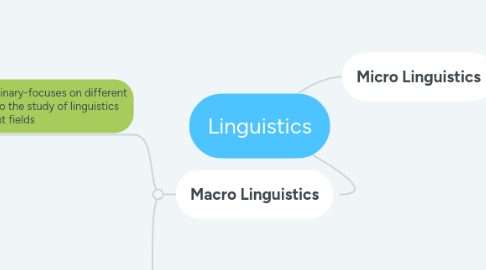
1. Micro Linguistics
1.1. Phonetics-focuses on the production and classification of the world's speech sounds.
1.2. Morphology-the study of how parts of words, called morphemes, create different meanings by combining with each other or standing alone.
1.3. Semantics-the branch of linguistics and logic concerned with meaning.
1.4. Phonology-systems of sounds (including or excluding phonetics), within a language or between different languages.
1.5. Pragmatics-focuses on conversational implicature, which is a process in which the speaker implies and a listener infers.
1.6. Syntax-grammatical structure of sentences. The format in which words and phrases are arranged to create sentences is called syntax.
2. Macro Linguistics
2.1. Intradisciplinary-focuses on different approach to the study of linguistics for different fields
2.1.1. Historical linguistics-studies the evolvement of diffe languages throughout the history
2.1.2. Comparative linguistics- study of the relationships or correspondences between two or more languages and the techniques used to discover whether the languages have a common ancestor.
2.1.3. Theoretical-studies the science of linguistics on theoretical basis without practical approaches
2.1.4. Applied linguistics-studies the implementation of linguistics in solving daily problems.
2.2. Interdisciplinary-studies the application of linguistics in correlation with other sciences
2.2.1. Geographical linguistics
2.2.2. Neurolinguistics
2.2.3. Cognative linguistics
2.2.4. Sociolinguistics
2.2.5. Psycholinguistics