
What factors could affect the time required to produce a specific amount of a chemical that is ma...

Stage 2 Chemistry Deconstruct and Design - Mindmap: Evidence of Deconstruction. Ore - 392251L The Essington School

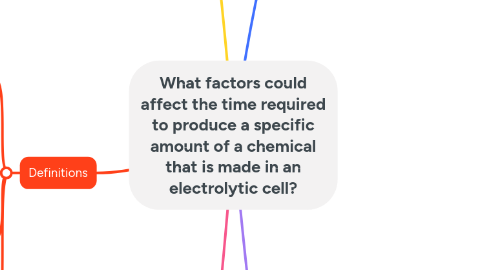
1. Methods of Electrolysis
1.1. **Molten Electrolysis**
1.1.1. Involves heating the metal salt past its melting point, to a liquid, to mobilise the ions.
1.1.1.1. **Method:** 1. Assemble heating apparatus. 2. Melt metal salt to form electrolyte. 3. Insert electrodes and turn on power supply. 4. Separate and weigh metal product.
1.1.1.1.1. **Justification:** Will not be used. Expensive and impractical for a school environment.
1.1.1.1.2. **Limitations:** Is highly energy intensive - requires high amounts of heat. Care must be taken to ensure high purity of molten substnace. Expensive. Increased burning hazards with molten metals.
1.1.1.1.3. **Benefits:** Can be used for the electrolysis of any metal - including insoluble oxides, and those more reactive than hydrogen.
1.2. **Aqueous Electrolysis**
1.2.1. Involves dissolving an ionic compound in water to mobilise the ions.
1.2.1.1. **Method:** 1. Dissolve solid metal salt in distilled water to create the electrolyte (this may need to be acidified, depending on metal salt's solubility in water). 2. Insert electrodes and turn on power supply. 3. Separate and weigh metal product.
1.2.1.1.1. **Benefits:** Requires significantly less energy than molten electrolysis. Safer. Less expensive. Sometimes results in the production of a gas (halide) at the anode, which can make measuring rate of reaction easier.
1.2.1.1.2. **Limitations:** Cannot be used for insoluble compounds, or in conjuction with metals more reactive than hydrogen.
1.2.1.1.3. **Justification:** Will be used. It is not difficult to source a soluble metal compound less reactive than hydrogen. Less energy intensive than molten electrolysis, thus more practical, meaning it is a suitable method to use in a school lab. Gas production will also provide a good option to measure rate of reaction.
2. Definitions
2.1. **Electrolysis**
2.1.1. An electrical current (electrical energy) is passed through a substance to initiate a chemical change (chemical energy).
2.1.1.1. It follows that any alteration that changes the amount of **electrical energy** able to do work, will affect the rate of the chemical change.
2.1.2. Etymology: 'Electro' - Relating to electricity, or input of electrical energy. 'Lysis' - Relating to the splitting of a component into two separate components.
2.1.3. Applications: Electroplating, metal refining, metal purification, production of some chemicals (i.e hydrogen and oxygen).
2.2. **Time Required**
2.2.1. 'Time required' alludes to the **rate of reaction** of the electrolysis. The less time required, the faster the rate of reaction.
2.3. **Specific amount of a chemical**
2.3.1. Electrolysis products can include atoms, molecules, ions and/or gases.
2.3.1.1. Of these, gases and atoms will be the easiest to measuure. Gas prodution is likely to produce visible **effervescence**, and changes in the quantity of atoms will resut in fluctuations of the masses of the electrode(s).
3. Possible Chemicals
3.1. **Hydrogen (Water electrolysis)**
3.1.1. Hydrogen gas is extremely explosive in oxygen. Risks involved.
3.1.1.1. Will not be used
3.2. **Copper**
3.2.1. Affordable and relatively abundant. Suitable for aqueous electrolysis.
3.2.1.1. Copper is chosen over zinc, as it is less reactive - meaning it requires a lower voltage for reduction. This is more energy efficient.
3.2.1.1.1. Salt
3.3. **Zinc**
3.3.1. Affordable and relatively abundant. Suitable for aqueous electrolysis.
3.4. **Gold**
3.4.1. Expensive. Relatively unreactive, thus unsuitable for electrolysis.
3.4.1.1. Will not be used
3.5. **Silver**
3.5.1. Expensive
3.5.1.1. Will not be used.
3.6. **Iron**
3.6.1. More reactive than hydrogen. Unsuitable for aqueous electrolysis.
3.6.1.1. Will not be used
3.7. **Aluminium**
3.7.1. Reactive metal. Hydrogen will be preferentially reduced, if water is present. Insoluble in water. Unsuitable for aqueous electrolysis.
3.7.1.1. Will not be used
3.8. **Sodium**
3.8.1. Extremely reactive. Difficult to store. Is not suitable for aqueous electrolysis, as hydrogen will be preferentially reduced.
3.8.1.1. Will not be used
4. Possible Independent Variables and Justifications
4.1. **IV**
4.1.1. Explanation
4.1.1.1. How will it be changed?
4.1.1.1.1. Justification
4.2. **Temperature**
4.2.1. Ionic conductivity increases with temperature, as constituent ions have more kinetic energy. This is summarised by the Nernst equation: connection on right - where E=reduction potential, and T=temperature. Ionic conductivity of an electrolyte is dependent on its electrical conductivity due to the movement of its ions. Thus, an increase in ionic conductivity means ions in the electrolyte can carry their charge to the electrodes quicker (greater current), thus increasing rate of reaction. This can be seen in the Nernst equation from the direct proportionality between the cell's reduction potential (E) and temperature (T) (E∝T).
4.2.1.1. Using a heat bath to adjust temperature of electrolytes before conducting electrolysis.
4.2.1.1.1. Will not be used. It is unlikely the temperatures of the electrolytes will be mantained for the duration of the experiments, due to heat loss to the surroundings.
4.3. **pH**
4.3.1. Rate of electrolysis is dependent on electrical conductivity of the electrolyte. The more conductive the electrolyte is, the faster the ions can carry charge accross the cell, thus the greater the current. Increasing or decreasing pH (away from 7) increases concentration of H+/OH- ions. These are mobile charge carriers, thus conductivity is increased.
4.3.1.1. Acidfying electrolyte prior to electrolysis, by adding H+ ions. Can create electrolytes of varying pH by adjusting amount of H+ ions added,
4.3.1.1.1. Will not be used. Adding H+ ions is achieved by adding a strong acid (e.g sulfuric acid) to the electrolyte. This could affect other variables such as the volume (and hence concentration) of the electrolyte.
4.4. **Presence of impurities**
4.4.1. Impurities disrupt movement of ionic charge carriers, thus reducing electrical conductivity. Current decreases, causing a reduction in rate of electrolysis.
4.4.1.1. Can varying amounts of an inert impurity to electrolytes prior to electrolysis. Electrolytes must be the same in all respects except from the amount of impurities present.
4.4.1.1.1. Will not be used. It may be difficult to find an impurity that has no effect on the reactions.
4.5. **Nature of electrode**
4.5.1. Electrolysis with an active electrode will have a greater rate than electrolysis with an inert electrode. Inert electrodes do not take part in any of the reactions involved, simply provide electrons.
4.5.1.1. May conduct two different electrolysis experiments with different pairs of electrodes. The electrolyte and all other components of the cell must remain the same. An ionic compound which may undergo electrolysis with active as well as inactive compounds must be selected.
4.5.1.1.1. Will not be used. There are only two trials for this investigation - active and inactive electrode. This means there is a small sample size, and trends can not be adequately identified.
4.6. **Concentration of electrolyte**
4.6.1. This increases the amount of charge carrying ions in the solution. Cuurent is increased, thus rate of electrolysis is increased.
4.6.1.1. Can create electrolytes identical in all respects except concentration, by dissolving them in varying volumes of water.
4.6.1.1.1. Will be used. Concentration of electrolyte is easy to alter. Incremental increases to concentration can allow for a large sample size, and adequate identification of strength and direction of correlation between the variables.
4.7. **Voltage**
4.7.1. Increasing voltage increases current, as stated by Ohm's Law (V=IR, V∝I). As current is increased, so is the rate of electrolysis.
4.7.1.1. Can vary potential difference across cell by applying a battery with a greater/lesser voltage.
4.7.1.1.1. Will not be used. Increasing voltage will also increase temperature. This will make it difficult to identify the variable that is causing the change.
5. Possible Depedent Variables and Justifications
5.1. **Dependent Variable**
5.1.1. Explanation
5.1.1.1. How will it be measured?
5.1.1.1.1. Limitations/Benefits
5.2. **Resultant current**
5.2.1. As electrolysis results in the formation of charge carrying **ions**, the greater the rate of electrolysis, the greater the formation of ions. More ions equates to charge circulating round the cell at a faster rate = current.
5.2.1.1. By using an ammeter connected in series. Resultant current is measured in amperes.
5.2.1.1.1. **Limitations:** Precision limited by resolution of ammeter. Possibility for systematic error caused by resistance in wire. (I∝1/R). If inert electrodes are used, electrolyte concentration will decrease as the electrolysis takes place. **Benefits:** Minimal room for human error.
5.3. **Effervescence**
5.3.1. In aqueous electrolysis involving the use of halide anions, these ions are oxidised to gases at the anode. Production of gas is often visible through the formation of bubbles at the fluid's surface (effervescence). The faster the rate of electrolysis, the more effervescene is produced.
5.3.1.1. By counting the number of bubbles released.
5.3.1.1.1. **Limitations:** Cannot be used for extremely fast rate of gas production. Cannot be used if the rate of gas production is too small to produce visible effervescene. Room for random error if number is miscounted. **Benefits:** Minimal equipment required.
5.3.1.2. Water displacement method: Electrolysis must be carried out in sealed container. Connective tubing leading from electrolysis chamber to inverted graduated cylinder placed in a water bath. (see appendix A for diagram)
5.3.1.2.1. **Limitations:** Gas must be insoluble/have low solubility in water. Volume of gas produced must be significant enough to create visible displacement of water. Graduated cylinder must be precise enough to record this displacement. **Benefits:** High accuracy. Less room for human error.
5.4. **Mass of electrodes**
5.4.1. Metal cations are reduced to metals at the cathode. If the anode is a pure metal, metal atoms are oxidised to metal cations (that go into solution) at the anode. The rate at which the mass of the cathode increases, and anode decreases is indicative of rate of electrolysis.
5.4.1.1. By measuring mass of cathode before and after electrolysis, using a balance.
5.4.1.1.1. **Limitations:** Electrolysis must occur for long enough to produce a sufficient change in electrode mass. **Benefits:** Provides precise and accurate measurements. Minimal room for human error.
5.4.1.2. By measuring mass of anode before and after electrolysis