


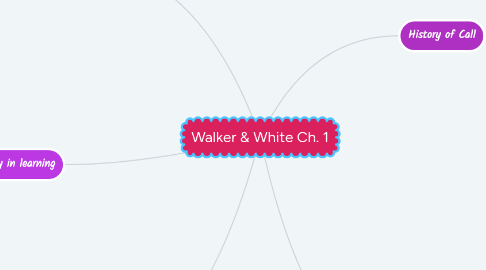
1. Communicative Competence
1.1. Ability to effectively use language to communicate in real life situations
1.1.1. Discourse Competence
1.1.1.1. Ability to create and use larger pieces of language to create texts or conduct conversations
1.1.2. Strategic Competence
1.1.2.1. Ability to manage and navigate communication
1.1.3. Sociolinguistic Competence
1.1.3.1. Understand how the language is used
1.1.4. Linguistic Competence
1.1.4.1. let us to know how the language works
2. Roles of Technology in learning
2.1. Tutor
2.1.1. Computer as teacher
2.1.1.1. The knowledge resides in the machine
2.2. Tutee
2.2.1. Learner teaches the computer
2.2.1.1. Knowledge is constructed more effectively when learners are forced to articulate their knowledge
2.3. Tool
2.3.1. Technology to achieve a task
2.3.1.1. Computers and digital technology as aids
3. Digital Competence
3.1. Digital competence refers to the ability to effectively navigate, evaluate, and create digital content using various technologies.
3.1.1. Strategic Competence
3.1.1.1. The ability to use language strategically to achieve communication goals effectively in various contexts
3.1.2. Digital-discourse Competence
3.1.2.1. Ability to engage in Digital platforms
3.1.3. Socio-digital Competence
3.1.3.1. Ability to participate in digital environments
3.1.4. Procidural Competence
3.1.4.1. Exeution of language-related tasks and procedures
4. History of Call
4.1. Warschauer and Kern (2000)
4.1.1. 1.Behaviouristic/Structural CALL
4.1.1.1. Focuses on observable behaviors and responses, employing techniques like reinforcement and conditioning to modify behaviors.
4.1.2. 2. Communicative open CALL
4.1.2.1. Centers around effective exchange of information, ideas, or emotions, emphasizing clarity, coherence, and mutual understanding.
4.1.3. 3. Integrative CALL
4.1.3.1. Involves blending various elements such as language skills, cultural understanding, and contextual knowledge to create a unified and comprehensive communication experience.
4.2. Bax (2003)
4.2.1. 1.Restricted CALL
4.2.1.1. Focuses on observable behaviors and responses, using techniques like reinforcement and conditioning to modify behaviors.
4.2.2. 2. Open CALL
4.2.2.1. Participants have the freedom to express themselves openly and engage in dialogue without significant constraints, encouraging diverse perspectives and creative thinking.
4.2.3. 3. Integrated CALL
4.2.3.1. Involves blending various elements such as language skills, cultural understanding, and contextual knowledge to create a unified communication experience.
5. From CALL to TELL
5.1. Evolution of language education in respons to advancing technology. Initially, CALL primarily focused on computer-based language learning activities. However, with the nproliferation of digital tools and platforms, TELL acknowledges a broader range of technologies, including mobile devices, online resources, and multimedia content.
5.1.1. TELL: Technology as part of the environment
5.1.2. CALL: Technology seen as assiting language learning