


1. PROCESSES FOR GRAMMAR ACQUISITION - Tricia Hedge
1.1. NOTICING
1.2. REASONING AND HYPOTHESIZING
1.3. STRUCTURING AND RESTRUCTURING
1.4. AUTOMATIZING
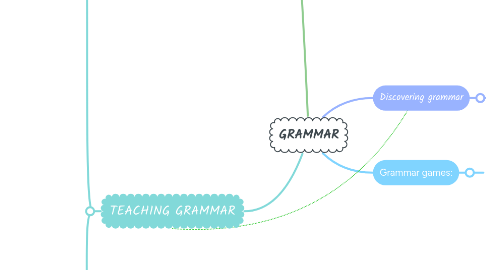
2. TEACHING GRAMMAR
2.1. Teachers have a wide variety of methods to choose when it comes to teaching grammar. However, there are important approaches.
2.1.1. INDUCTIVE APPROACH - Bourke (1996)
2.1.1.1. For example, when student have to construct the grammar structure themselves using the examples or evidence given (context).
2.1.1.1.1. Through the interaction with pictures or reading texts before any specific piece of grammar. This can be done using leading questions.
2.1.1.2. Definition: learners are encouraged to look for regularities in the TL input and formulate rules for themselves.
2.1.2. DEDUCTIVE APPROACH- Sheen (1992)
2.1.2.1. For example, using the grammar chart with the structure explicitly shown.
2.1.2.2. Definition: the learners are explicitly taught the rules of particular features of the target language (TL)
2.2. A CONSCIOUSNESS-RAISING (C-R) APPROACH
2.2.1. Consciousness-raising (CR) tasks, can be either deductive or raising tasks inductive,
2.2.1.1. C-R activities main characteristics (Ellis, 2002)
2.2.1.1.1. There should be an effort to isolate a specific linguistic feature for focused attention.
2.2.1.1.2. The learners are provided with data, which illustrate the targeted feature and an explicit rule description or explanation.
2.2.1.1.3. The learners are expected to utilise intellectual effort to understand the targeted feature.
2.2.1.1.4. Misunderstanding or incomplete understanding of grammatical structure by the learners leads to clarification in the form or further data and description or explanation
2.2.1.1.5. Learners are required to articulate the rule describing the grammatical feature.
2.2.2. Pieces of advice for implementing consciousness-raising tasks
2.2.2.1. The successfulness of the proposed activities may vary from one teaching context to another.
2.2.2.2. Before the teacher proceeds to the proposed C-R activities, she or he needs to model how to work on such activities.
2.2.2.3. Although the C-R based activities are much time consuming, and with this approach the learners are the recipient of the rule, such an approach is believed to be useful to internalise the rule into their comprehension about the sentence patterns taught (Widodo,2006)
2.2.2.4. The teacher needs to be critically aware of which parts of grammar should be done through such an approach.
2.2.2.5. The teacher needs to know when the students work individually or in pairs.
2.2.3. Definition: Techniques that encourage learners to pay attention to language form in the belief that an awareness of form will contribute indirectly to language acquisition.
3. Discovering grammar
3.1. The students are encouraged to work out for themselves how language forms are constructed and used. Harmer, J. (2015)
4. Grammar games:
4.1. will engage the students and encourage them to use the target structures with enthusiasm.
4.1.1. Many games from television and radio (and games that people play at home in their everyday lives) can be adapted for classroom use