

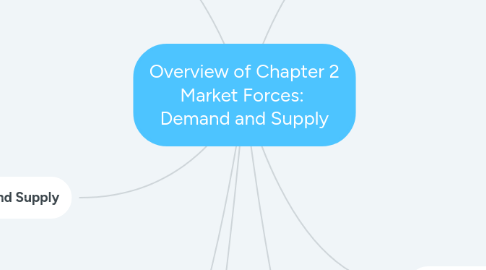
1. 3) Market Equillibrium
1.1. Definition: The point where the quantity demanded equals the quantity supplied.
1.2. Equilibrium Price: The price at which market equilibrium is achieved.
1.3. Equilibrium Quantity: The quantity bought and sold at the equilibrium price.
1.4. Graphical Representation: The intersection of the demand and supply curves.
1.5. Graphical Representation: The intersection of the demand and supply curves.
1.6. Market Disequilibrium: Situations where there is excess demand (shortage) or excess supply (surplus).
2. 4) Shifts in Demand and Supply
2.1. Shifts in Demand
2.1.1. Increase in Demand: Demand curve shifts right.
2.1.2. Decrease in Demand: Demand curve shifts left.
2.2. Shifts in Supply
2.2.1. Increase in Supply: Supply curve shifts right.
2.2.2. Decrease in Supply: Supply curve shifts left.
2.3. Effects on Equilibrium
2.3.1. Rightward Shift in Demand: Increases equilibrium price and quantity.
2.3.2. Leftward Shift in Demand: Decreases equilibrium price and quantity.
2.3.3. Rightward Shift in Supply: Decreases equilibrium price and increases quantity.
2.3.4. Leftward Shift in Supply: Increases equilibrium price and decreases quantity.
3. 5) Elasticity
3.1. Price Elasticity of Demand (PED): Measures the responsiveness of quantity demanded to a change in price.
3.1.1. Elastic: PED > 1
3.1.2. Inelastic: PED < 1
3.1.3. Unitary Elastic: PED = 1
3.2. Income Elasticity of Demand: Measures the responsiveness of demand to a change in income.
3.2.1. Normal Goods: Positive income elasticity.
3.2.2. Inferior Goods: Negative income elasticity.
3.3. Cross-Price Elasticity of Demand: Measures the responsiveness of demand for one good to a change in the price of another good.
3.3.1. Substitutes: Positive cross-price elasticity.
3.3.2. Complements: Negative cross-price elasticity.
3.4. Price Elasticity of Supply (PES): Measures the responsiveness of quantity supplied to a change in price.
3.4.1. Elastic: PES > 1
3.4.2. Inelastic: PES < 1
3.4.3. Unitary Elastic : PES = 1
4. 7) Government Intervention
4.1. Price Controls
4.1.1. Price Ceiling: A maximum price set below equilibrium (e.g., rent control).
4.1.2. Price Floor: A minimum price set above equilibrium (e.g., minimum wage).
4.2. Taxes and Subsidies
4.2.1. Tax on Goods: Shifts the supply curve upward by the amount of the tax.
5. 1) Understanding Demand
5.1. Definition: The quantity of a good or service consumers are willing and able to purchase at various prices.
5.2. Law of Demand: As the price of a good decreases, the quantity demanded increases, and vice versa, ceteris paribus.
5.3. Demand Curve: A downward-sloping curve representing the relationship between price and quantity demanded.
5.4. Factors Affecting Demand:
5.4.1. Price: Movement along the demand curve
5.4.2. Income: Normal vs. Inferior goods
5.4.3. Prices of Related Goods: Substitutes and complements
5.4.4. Tastes and Preferences: Consumer preferences and trends
5.4.5. Expectations: Future price and income expectations
5.4.6. Number of Buyers: Changes in population and demographics
6. 2) Understanding Supply
6.1. Definition: The quantity of a good or service producers are willing and able to sell at various prices.
6.2. Law of Supply: As the price of a good increases, the quantity supplied increases, and vice versa, ceteris paribus.
6.3. Supply Curve: An upward-sloping curve representing the relationship between price and quantity supplied.
6.4. Factors Affecting Supply:
6.4.1. Price: Movement along the supply curve.
6.4.2. Input Prices: Costs of production inputs.
6.4.3. Technology: Advances in technology that affect production efficiency.
6.4.4. Expectations: Future price expectations.
6.4.5. Number of Sellers: Market entry and exit of firms.
6.4.6. Taxes and Subsidies: Government interventions affecting production costs.