


Heating Earth's Surface and Atmosphere
by Durar Alenezi
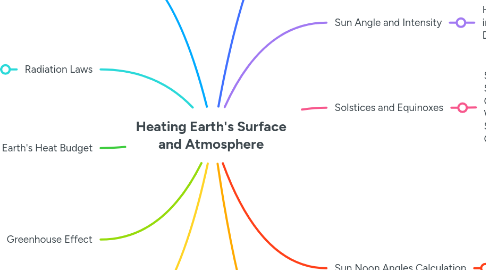
1. Heat Transfer Mechanisms
1.1. Conduction Heat transfer through molecular collisions Convection Heat transfer via substance movement (thermal currents) Radiation Electromagnetic spectrum, including visible light, infrared, ultraviolet
2. Radiation Laws
2.1. All objects emit radiation Hotter objects emit more and shorter wavelength radiation Good absorbers are good emitters
3. Earth's Heat Budget
3.1. Balance of incoming and outgoing radiation 30% of solar radiation is reflected; 70% is absorbed
4. Greenhouse Effect
4.1. Natural phenomenon trapping outgoing radiation Key gases: Carbon dioxide, water vapor Effects of deforestation on radiation emission
5. Atmospheric Scattering
5.1. Reflection, scattering, backscattering of light Causes of blue sky, red sunsets Role of atmospheric gases (e.g., nitrogen, carbon dioxide, water vapor, oxygen)
6. Earth-Sun Relationships
6.1. Principal Motions of Earth
6.1.1. Rotation: Spinning of Earth on its axis (day/night cycle) Revolution: Movement around the Sun (annual cycle) Perihelion: Closest point to the Sun (January 3) Aphelion: Farthest point from the Sun (July 4)