BIM Overview
by raviteja taduturi
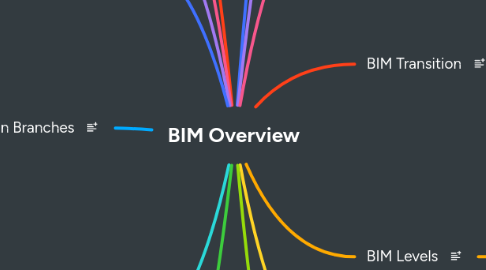
1. Additional components
1.1. Data Management
1.2. Client engagement
2. Collaboration tool
2.1. CDE-Common Data Environment
2.2. BIM collaboration platforms
3. Early Adopters
4. High-Level Concept
5. Main Branches
5.1. Project goals and scope
5.2. BIM technology
5.3. Collobaration and communication
5.4. Implementing and execution. 4
5.5. Model development & Analysis .5
5.6. Continous Improvement .6
6. Definition
6.1. Building Information Modeling (BIM) is a digital process used to create detailed 3D models of structures, enhancing design, construction, and operation efficiency
7. Data
7.1. Raw Data
7.2. Processing Information
7.3. Knowledge Actions
7.4. Decision Making
8. Training and development
8.1. Software training
8.2. Process training
8.3. Technical knowledge enhancement
9. Risk Management
9.1. Risk identification
9.2. Mitigation strategies
9.3. Continuous monitoring
10. Emerging Trends
10.1. Artificial Intelligence
10.2. Internet of things
10.3. Virtual and Augmented reality
11. BIM Transition
11.1. BIM promotes collaboration among all members of a project team
11.2. BIM allows the design to look as a whole
11.3. Digitally prototype a construction project, affirming design intent
12. BIM Levels
12.1. 2D CAD/3D CAD collobaration
12.2. Data sharing
12.3. Integrationan and data sharing
13. BIM Softwares
13.1. Revit
13.2. Archicad
14. Change in Approach
14.1. Detailed Design
14.2. Analysis
14.3. Documentation
14.4. Fabricartion
14.5. Construction Logistics
14.6. Conceptual Desing
14.7. Operation Management


