


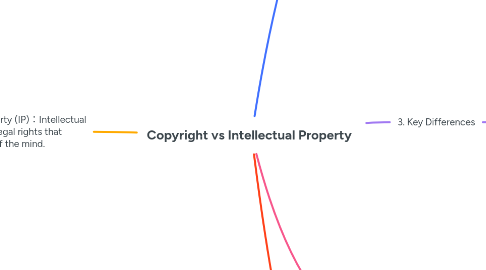
1. 1. Intellectual Property (IP):Intellectual Property refers to legal rights that protect creations of the mind.
1.1. 1.1 Types of Intellectual Property
1.1.1. Copyright
1.1.2. Patent
1.1.3. Trade Secret
1.1.4. 1.3 Intellectual Property in Education
1.2. 1.2 Purpose of Intellectual Property
1.2.1. Protect creators’ rights
1.2.2. Encourage innovation and creativity
1.2.3. Support economic and educational development
1.3. 1.3 Intellectual Property in Education
1.3.1. Educational software
1.3.2. Learning platforms
1.3.3. Teaching materials
1.3.4. Research outcomes
2. 2. Copyright: Copyright is a type of intellectual property that protects original works of authorship.
2.1. 2.1 What Copyright Protects
2.1.1. Books and textbooks
2.1.2. Lecture slides and notes
2.1.3. Videos and audio recordings
2.1.4. Images and graphics
2.1.5. Student assignments and projects
2.2. 2.2 What Copyright Does NOT Protect
2.2.1. Ideas or concepts
2.2.2. Common knowledge
2.2.3. Facts and data
2.3. 2.3 Copyright Ownership in Education
2.3.1. Teachers own original teaching materials
2.3.2. Students own their original assignments
2.3.3. Institutions may have shared ownership
3. 3. Key Differences
3.1. 3.1 Scope
3.1.1. Intellectual Property: a broad legal concept
3.1.2. Copyright: one specific type of IP
3.2. 3.2 Protection Focus
3.2.1. Intellectual Property: protects ideas turned into legal rights
3.2.2. Copyright: protects the expression of ideas
3.3. 3.3 Examples in Education
3.3.1. IP: educational apps, patented tools, school logos
3.3.2. Copyright: lecture slides, textbooks, videos
4. 4. Importance in the Education Field
4.1. 4.1 For Teachers
4.1.1. Protect original teaching materials
4.1.2. Avoid copyright infringement
4.1.3. Use licensed or open resources
4.2. 4.2 For Students
4.2.1. Respect others’ work
4.2.2. Avoid plagiarism
4.2.3. Understand fair use in learning
5. 5. Fair Use and Open Educational Resources (OER)
5.1. 5.1 Fair Use in Education
5.1.1. Limited use for teaching and learning
5.1.2. Use for non-commercial purposes
5.1.3. Proper citation is required
5.2. 5.2 Open Educational Resources (OER)
5.2.1. Free and open learning materials
5.2.2. Can be reused, adapted, and shared
5.2.3. Licensed under Creative Commons