
English Reading Education in Chinese High Schools (AI as reading companion rather than answering ...


English Reading Education in Chinese High Schools (AI as reading companion rather than answering machine)
by 夏日韩 Unknown
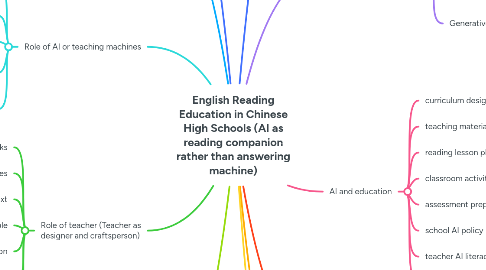
1. Connections with other technologies
1.1. machine translation
1.2. digital textbooks
1.3. corpus tools
2. Purpose of reading, beyond test scores
2.1. understanding ideas
2.2. interpret author's attitude
2.3. recognize emotion and tone
2.4. connect text with experience
2.5. develop critical and creative thinking
3. Role of AI or teaching machines
3.1. help students ask questions, not to solve them
3.2. give background knowledge
3.3. offers alternative interpretations
3.4. encourage students to find details themselves
3.5. support reflecting and misunderstnding
4. Role of teacher (Teacher as designer and craftsperson)
4.1. design reading tasks
4.2. teach basic AI use rules
4.3. guide students back to the text
4.4. judge whether AI output is suitable
4.5. support discussion
4.6. prevent leaning from being technically cantered
4.7. find out learning goles
5. Learning process (they construct meaning themselves)
5.1. they make meaning through interaction with AI tools, peers and teachers
5.2. they explain their own interpretation of the texts
5.3. they compare different understandings
5.4. they debug misunderstandings with the help of AI, teacher and classmates
5.5. reflec on the reading content and the skills they have learned
6. Current context
6.1. Chinese high school English
6.2. Gaokao pressure
6.3. large class size
6.4. vocabulary and grammar focus
6.5. teacher centered structure
6.6. main idea, details, inference, author’s attitude
6.7. unequal digital access
6.8. answer-focused reading
7. Current technology use
7.1. digital dictionaries
7.2. translation apps
7.3. digital textbooks
7.4. English learning apps
7.5. Generative AI tools
7.5.1. AI chatbots
7.5.2. AI summarisation
7.5.3. Teacher use of AI to prepare materials
7.5.4. AI question generation