


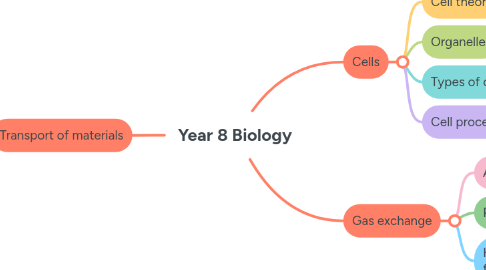
1. Transport of materials
1.1. Plants
1.1.1. Xylem
1.1.1.1. Transport water and minerals
1.1.1.2. One-way flow (upwards)
1.1.1.3. Made of dead cells
1.1.1.4. No cell endings
1.1.1.5. Transpiration causes upward movement
1.1.1.5.1. Water vapour is lost through leaves
1.1.1.5.2. Causes water to continue moving up through the Xylem
1.1.2. Phloem
1.1.2.1. Transport glucose (sugars)
1.1.2.2. Two-way flow (up + down)
1.1.2.3. Made of living cells
1.1.2.4. Cells end in sieve plates
1.2. Animals (vertebrates)
1.2.1. Closed circulatory systems
1.2.1.1. Heart
1.2.1.1.1. Muscular organ that pumps blood around the body
1.2.1.1.2. Double-pump
1.2.1.1.3. Two sides
1.2.1.2. Blood
1.2.1.2.1. Plasma
1.2.1.2.2. Red blood cells
1.2.1.2.3. White blood cells
1.2.1.2.4. Platelets (in mammals)
1.2.1.3. Blood vessels
1.2.1.3.1. Arteries
1.2.1.3.2. Veins
1.2.1.3.3. Capillaries
1.3. Purpose
1.3.1. To move materials around the organism
1.3.1.1. Water
1.3.1.2. Gases
1.3.1.3. Nutrients
1.3.1.4. Waste porducts
2. Cells
2.1. Cell theory
2.1.1. All cells come from pre-existing cells
2.1.2. Cells are the basic unit of life and function
2.1.3. All organisms are made of one or more cells
2.2. Organelles
2.2.1. Plant cells only
2.2.1.1. Chloroplasts
2.2.1.1.1. Site of photosynthesis
2.2.1.1.2. Contain the green pigment chlorophyll
2.2.1.2. Cell wall
2.2.1.2.1. Rigid outer layer that gives more support to cells
2.2.1.3. Large vacuole
2.2.1.3.1. Stores water, nutrients and wastes
2.2.2. Both plant and animal cells
2.2.2.1. Mitochondria
2.2.2.1.1. Site of energy production
2.2.2.2. Nucleus
2.2.2.2.1. Contains DNA and controls cell functions
2.2.2.3. Ribosomes
2.2.2.3.1. Makes proteins
2.2.2.4. Endoplasmic Reticulum
2.2.2.4.1. Tranport materials around the cell
2.2.2.5. Golgi body
2.2.2.5.1. Assembles and packages proteins
2.2.2.6. Cytoplasm
2.2.2.6.1. Gel-like substance that fills the cell
2.2.2.7. Cell membrane
2.2.2.7.1. Surrounds and protects the cell
2.2.2.7.2. Controls materials moving in and out of cell
2.2.3. Animal cells only
2.2.3.1. Small vacuole
2.2.3.1.1. Stores water, nutrients and wastes
2.3. Types of cells
2.3.1. Prokaryote
2.3.1.1. No membrane-bound organelles
2.3.1.2. No nuclues - DNA floats around cell
2.3.1.3. Only found in unicellular organisms
2.3.1.4. Very small
2.3.2. Eukaryote
2.3.2.1. Have membrane bound organelles
2.3.2.2. Has a nucleus containing DNA
2.3.2.3. Found in both unicellular and multicellular organisms
2.3.2.4. Larger than prokaryotic cells
2.4. Cell processes
2.4.1. Photosynthesis
2.4.1.1. In plant cells
2.4.1.2. Uses sunlight to produce glucose
2.4.1.3. Water + Carbon dioxide --> Glucose + Oxygen
2.4.1.4. Occurs in chloroplasts
2.4.2. Celular respiration
2.4.2.1. In both plant and animal cells
2.4.2.2. Occurs in mitochondria
2.4.2.3. Uses glucose and oxygen to produce energy
2.4.2.4. Oxygen + Glucose --> Water + Carbon Dioxide + Energy (ATP)
3. Gas exchange
3.1. Animals (vertebrates)
3.1.1. Respiratory systems
3.1.1.1. Lungs
3.1.1.1.1. Mammals
3.1.1.1.2. Birds
3.1.1.2. Gills
3.1.1.2.1. Aquatic vertebrates (fish)
3.1.2. Purpose
3.1.2.1. Need oxygen for cellular respiration
3.2. Plants
3.2.1. Stomata
3.2.1.1. Small openings in leaves
3.2.1.1.1. Carbon dioxide diffuses in
3.2.1.1.2. Oxygen and water vapour diffuse out
3.2.1.2. Controlled by guard cells
3.2.1.2.1. Opening
3.2.1.2.2. Closing
3.2.2. Purpose
3.2.2.1. Need carbon dioxide for photosynthesis
3.2.2.2. Create oxygen in photosynthesis which needs to be released
3.3. How are these systems effective for gas exchange?
3.3.1. Large surface area
3.3.1.1. Thousands of stomata on each leaf
3.3.2. Moist surface
3.3.2.1. Gases can dissolve before they diffuse
3.3.3. Very thin
3.3.3.1. Small distance for gases to travel
3.3.4. Animals: Good blood supply
3.3.4.1. Alveoli are surrounded by capillaries
3.3.4.2. Gills have lots of capillaries inside them