

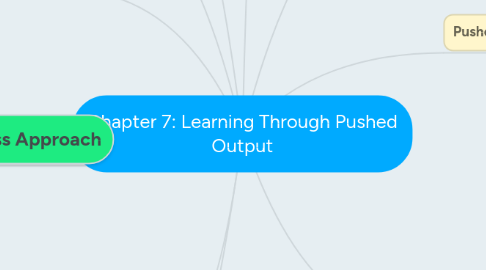
Chapter 7: Learning Through Pushed Output
by Julie Gladstone
1. Formal Speaking
1.1. Control of Content, Awareness of Audience, Focus of Attention
1.2. Experience the Listener's POV
1.3. Work through series of complexity
2. The Nature of Formal Speaking
2.1. Generally for work or academic study
2.2. Transactional, long turns, influenced by writing, "careful" style, needs to be taught
3. Teaching Formal Speaking
3.1. Focus on Successful Communication
3.2. Organize ideas, Use a framework, Plan in a group
3.3. May be scripted, Provide nonthreatening opportunities
4. A Process Approach
4.1. Divide the Tasks
4.1.1. Presenting and monitoring
4.1.2. Gathering ideas
4.1.3. Organizing ideas
4.1.4. Making speaking notes
4.1.5. Goals and audience
5. Presenting a Formal Talk
5.1. 1. Limit to 3-4 pieces of information
5.2. 2. Present or gradually build up simple outline of main points
5.3. 3. 3-4 changes of focus of attention during the talk
5.4. 4. Audience should be involved in talk
6. Monitoring Formal Speaking
6.1. Goals and Audience
6.2. Ideas
6.3. Organization
6.4. Notes
6.5. Presentation
7. Introduction
7.1. Pushed Output
7.2. Informal Speaking
7.3. Formal Speaking
7.4. Activities
8. Informal Speaking
8.1. Interactional
8.2. Teach Conversation Strategies
8.3. Supportive Conversation Partners
8.4. Repeated Tasks
8.5. Can be Prepared for!
9. Pushed Output
9.1. Factors to consider
9.2. Topic
9.3. Text Type
9.4. Performance Conditions
9.4.1. Planning
9.4.2. Retelling
9.4.3. Time Pressure
9.4.4. Amount of Support
9.4.5. Standard of Performance