

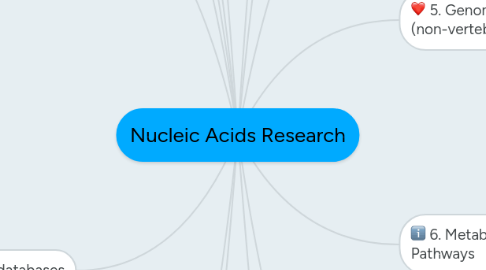
1. 8. Human Genes and Diseases
1.1. CancerResource
1.1.1. The database provides information of drug and targeted cancer cells. The database retrieve information from PubMed abstract and cancer-related drug-target interactions were from sources such as CTD, PharmGKB, TTD, DrugBank and PDB.
1.2. General human genetics databases
1.2.1. Genetics Home Reference
1.2.1.1. The database provides the information of genetic variation to human health. It includes the gene position on chromosome, product of the gene and other external references.
1.2.1.1.1. can be use to determine chitinase related gene diseases and other related genes.
1.3. General polymorphism databases
1.4. Cancer gene databases
1.5. Gene-, system- or disease-specific databases
2. 9. Microarray Data and other Gene Expression Databases
2.1. GXD-Mouse Gene Expression Database
2.1.1. Community resource for gene expression information from the laboratory mouse.
2.2. Gene Expression Omnibus (GEO)
2.2.1. Public functional genomics data repository that archives and freely distributes microarray, sequencing, and other forms of high-throughput functional genomics data submitted by the research community.
2.2.1.1. GEO DataSets stores original submitter-supplied records (Series, Samples and Platforms)
2.2.1.2. GEO Profile stores gene expression profiles derived from curated GEO DataSets.
3. 10. Proteomics Resources
3.1. BIOZON
3.1.1. Unified biological database that integrates heterogeneous data types such as proteins, structures, domain families, protein–protein interactions and cellular pathways, and establishes the relationships between them.
3.1.1.1. Graphically relate Chitinase to its protein family, nucleic acid sequence and its interaction with other proteins.
4. 11. Other Molecular Biology Databases
4.1. PubMed
4.1.1. A database of citations and abstracts for biomedical literature from MEDLINE and additional life science journals
4.1.1.1. Relationship of AMCase with human disease
5. 12. Organelle databases
5.1. Organelle DB
5.1.1. Compiles protein localization data from organisms spanning the eukaryotic kingdom and presents an organized catalog of the known protein constituents of more than 50 organelles, subcellular structures, and protein complexes.
5.1.2. Organelle View offers a dimensional representation of a yeast cell; users can search Organelle View for proteins of interest, and the organelles housing these proteins will be highlighted in the cell image.
6. 13. Plant databases
6.1. Rice
6.1.1. Oryzabase
6.1.1.1. A database on rice strains of wild type, modified and classical breeding, providing chromosomal maps and gene dictionary for collection of strains and fundamental knowledge on rice science.
6.1.1.1.1. Provide name of gene (CGSNL), origins & trait class of chitinase
6.1.1.1.2. Provide information on gene, trait and plant ontologies of chitinase
6.1.1.1.3. Provide the information on discovery of chitinase (author, journal & reference ID)
6.2. Arabidopsis thaliana
6.2.1. Aramemnon
6.2.1.1. A curated database for Arabidopsis thaliana transmembrane (TM) proteins and transporters with topology and signal sequence predictions and display of results by reliable comparative graphical format.
6.2.1.1.1. Provide information on chitinase sequence, topology and clusters
6.2.1.1.2. Provide gene ontology for chitinase
6.2.1.1.3. Provide data on chitinase expression level on certain plant structures
6.2.1.1.4. View co-expression gene network of chitinase
6.3. General plant database
6.3.1. Phytozome
6.3.1.1. Comparative database for plant genomes by providing evolutionary history of plant gene at the level of sequence, gene structure, gene family and genome organization.
6.3.1.1.1. View information of gene such as locus and transcript name of chitinase
6.3.1.1.2. Able to BLAST & BLAT the selected gene sequence of chitinase
6.3.1.1.3. Compare the homologs of chitinase
6.3.1.1.4. View chitinase as in protein domain and genomic map
6.3.1.1.5. Provide information on gene ancestry of chitinase
7. 14. Immunological databases
7.1. MHCBN
7.1.1. The database provides information about allele specific MHC binding peptides, MHC non-binding, TAP binding, TAP non-binding peptides and T-cell epitopes reported in literature. The newer version is updated with MHC linked autoimmune diseases. It also provides several tools such as Query Searching, TAP Search, Peptide Mapping, Dataset Creation and Similarity Search.
7.1.1.1. helps to identify the chitinase that causes autoimmnue diseases by enzymatic products or environment.
7.2. HaptenDB
7.2.1. The database provides the information of various haptens, which is not immunogenic itself but unless paired with specific antibodies. There are 2021 entries of antibodies and haptens reaction information and 1087 haptens data with 2-D and 3-D structures. Search and analysis tools are also provided.
8. 15. Cell biology
8.1. BARC bd
8.1.1. designed for researchers who require information on how to make best use of valuable biospecimens from biobanks and other sample collections, focusing on the choice of analytical techniques and the demands they make on the type of samples, pre-analytical sample preparation and amounts needed.
8.2. DNAtraffic
8.2.1. Contains extensive data on the nomenclature, ontology, structure and function of proteins related to control of the DNA integrity mechanisms such as chromatin remodeling
8.2.2. To create the first platform of the combinatorial complexity of DNA metabolism pathway analysis.
9. categories
10. sub category
11. 2. RNA sequence databases
11.1. Technology that uses the capabilities of next-generation sequencing to reveal a snapshot of RNA presence and quantity from a genome at a given moment in time.
11.1.1. Rfam
11.1.1.1. The Rfam database provides alignments, consensus secondary structures and covariance models for RNA families.
11.1.1.2. For each ncRNA family, the interface allows users to: view and download multiple sequence alignments; read annotation; and examine species distribution of family members.
11.1.2. Genomic tRNA
11.1.2.1. Contains tRNA gene predictions made by the program tRNAscan-SE on complete or nearly complete genomes.
11.1.3. miRBase
11.1.3.1. Is a database of published miRNA sequences and annotations that provides a centralised system for assigning names to miRNA genes
12. 3. Protein sequence databases
12.1. General sequence databases
12.1.1. UniProt
12.1.1.1. A comprehensive and freely accesible protein sequence database by integrating, interpreting and standardizing data from numerous resources. It consists informations such as gene name, protein sequence/structure/function, expression and cellular location which derived from literature and divide into UniProtKB, UniParc, UnitRef and UniMes.
12.1.1.1.1. Prevent multiple protein data by merging protein sequence based on 100/90/50 identity into a single entry
12.1.1.1.2. Provide blast service to search homology chitinase.
12.1.1.1.3. Manually curated highly-annotated sequences to guide users to choose chitinase.
12.2. Protein properties
12.2.1. SwissSideChain
12.2.1.1. Structural and molecular mechanics database of hundreds of non-natural amino-acid sidechains that can be used to study in silico their insertion into natural peptides or proteins based on publicly available protein structure in PDB.
12.2.1.1.1. Description on physico-chemical properties (molecular weight, volume, logP, pKa, partial charges, bond/angle/torsion constants) of side chain
12.2.1.1.2. Determination on conformations in crystal structures
13. 4. Structure Databases
13.1. Protein Structure
13.1.1. SWISS-MODEL Repository
13.1.1.1. Database which consist three-dimensional protein models for a set of model organisms from UniProt. SWISS-MODEL workspace allow the template structure searching, model building and models assessment.
13.1.1.1.1. Frequently update on on protein sequence from UniProt cause many new template strucutre and increase quality of modeling of chitinase or other proteins.
13.1.1.1.2. Addition model quality assesment tools enhance the quality in homology modelling for proteins.
13.1.2. RCSB Protein Data Base
13.1.2.1. A curated 3D macromolecular database which can search, visualise and analyze molecule through the web services. The data can be stored by users in a file format(PDB/mmCIF/XML) that consists the details of structure solution, long list of the atoms and their coordinates.
13.1.2.1.1. Functional relationship between chitinase and other proteins can be analysed through sequence and structure alignments.
13.1.2.1.2. Visualisation tool display the strucutre of the protein and atoms, chains and domains.
14. 5. Genomics Databases (non-vertebrate)
14.1. Fungal genome database
14.1.1. Central Aspergillus Data Repository (CADRE)
14.1.1.1. Genomic data for Aspergillus sp. which provides graphical views of assembled sequence and mapped features such as genes and transcripts, allowing comparative analysis of genes
14.1.1.1.1. Provide origins of chitinase, gene sequence encoded for chitinase and the genetic alignments
14.1.1.1.2. Compare chitinase by homologs, paralogs and orthologs in different organisms
15. 6. Metabolic and Signaling Pathways
15.1. Protein-protein interactions
15.1.1. 3D-Interologs
15.1.1.1. The database aims at study orthologous protein-protein interaction with the help of BLAST to scan for proteins with high sequence similarities. It uses the existing information with novel scoring function and structure complexes to generate data of the interested protein based on the protein selected from BLAST.
15.1.1.1.1. from 3D-Inrelogs we can know the evolution and protein- protein interactions of chitinase across multiple species.
15.2. Enzymes and enzyme nomenclature
15.2.1. BRENDA
15.2.1.1. This database provide the information of the enzyme which includes nomenclature, enzyme-ligands interactions, functional parameters, organism related information, enzyme structure, molecular properties, related diseases, references and external link.
15.2.1.1.1. BRENDA show a systematic record and info of various chitinase data from organism to types of reactions it involve
15.3. Signalling pathways
15.3.1. PRRDB
15.3.1.1. The database provides information of pattern recognition receptors and their ligands, where the ligands can be used as adjuvant to improve vaccines function.
15.4. Prokaryotic genome databases
15.5. Metabolic pathways
16. 1. Nucleotide sequence database
16.1. International Nucleotide Sequence Database Collaboration
16.1.1. GenBank
16.1.1.1. Publicly available nucleotide sequences generated from sequencing biological molecule in the lab instead of computer-generated string of letters. The availability of sequence is contributed by direct submissions of DNA sequence from original authors. Data of DDBJ and ENA are exchanged daily to ensure the nucleotide sequence are updated.
16.1.1.1.1. -Existence of coding sequence on nucleic acid record ensure the discovery of chitinase or other proteins.
16.1.1.1.2. - Ensure precise information of coding feature on nucleic acid and ensure the data in other database(protein or nucleic acid) can prevent mislead discoveries.
16.2. Coding and non-coding DNA
16.2.1. ACLAME
16.2.1.1. A database which classify and analysis sequence of mobile genetic elements(MGE). Protein families are built from the MGE encoded proteins to provide comprehensive classification of MGE sequence, protein and gene.
16.2.1.1.1. BLAST search interface allow searching sequence
16.2.1.1.2. Provide information of host and its protein families and functions
17. 7. Human and other vertebrate genomes
17.1. Model organisms, comparative genomics
17.1.1. Agbase
17.1.1.1. A database for functional analysis of agricultural plant & animal gene products by developing expressed protein sequence tags (ePSTs) for structural annotation of genomes and Gene Ontology (GO) consortium to describe molecular function, biological process and cellular components for genes and gene products.
17.1.1.1.1. Provide gene ontology annotations in molecular function, biological process and cellular components of plants related to chitinase expression
17.1.1.1.2. Link to various other databases such as EMBL-EBI, UniProt, AmiGO 2 which facilitates during research
17.2. Human genome databases, maps and viewers
17.2.1. UCSC Genome Browser
17.2.1.1. Database of genomic sequence and annotations for organisms such as vertebrates with integrated tools for visualizing, comparing and analyzing genomic data sets. The database offers comparative data such as gene models, regulation, expression and so on
17.2.1.1.1. Show gene sequence, mRNA or genomic alignments and genomic size for chitinase
17.2.1.1.2. Provide information on gene expression and regulation of chitinase
17.2.1.1.3. Able to compare the gene sequence for chitinase among different vertebrates
17.2.1.1.4. Show repeats and variation of the gene sequence for chitinase
17.3. Human ORFs
17.3.1. Mammalian Gene Collection (MGC)
17.3.1.1. Database consisting of cDNA clones containing a full-length open reading frame (FL-ORF) for human, mouse and rat genes. The identified sequence are available in GenBank.
17.3.1.1.1. Provide origins of chitinase and gene sequence
17.3.1.1.2. Able to run BLAST and design primers for cDNA clone for chitinase
17.3.1.1.3. Able to express the chitinase gene in graphical format