


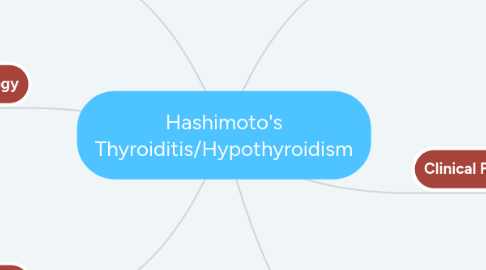
Hashimoto's Thyroiditis/Hypothyroidism
by Deidre Smith
1. Etiology/Risk Factors
1.1. Women 15-20x more likely than men
1.2. Iron-deficiency anemia
1.3. Diet
1.3.1. High iodine intake
1.3.2. Selenium deficiency
1.4. Autoimmune disorders
1.4.1. Rheumatoid arthritis
1.4.2. Type 1 diabetes
2. Pathophysiology
2.1. Chronic lymphocytic thyroiditis
2.2. Autoimmune T-cell proliferation
2.2.1. Attacks Thyroid Hormone
3. Manifestations
3.1. Increased sensitivity to cold
3.2. Constipation
3.3. Difficulty concentrating/thinking
3.4. Dry skin
3.5. Fatigue
3.6. Hair loss
3.7. Heavy and irregular menstruation
3.8. "Puffy" Face
3.9. Thickness of tongue and slurred speech
4. Nursing Considerations
4.1. Proper hygeine
4.2. Provide warmth
4.3. Teach importance of daily medication routine
4.3.1. Same time everyday
4.3.2. Take on empty stomach
4.4. PT monitor pulse rate 2x/wk
4.4.1. Tachycardia
4.4.1.1. Inform physician
4.4.1.1.1. Stop taking medication
4.4.1.2. Stop taking medication
5. Clinical Findings
5.1. Progresses slowly
5.1.1. Onset may not be observable
5.2. Goiter at front of throat
5.3. Low levels of thyroid hormone
5.3.1. Chronic thyroid damage
5.4. Antibodies against thyroid peroxidase
5.5. Preorbital edema
5.6. Low temperature
5.7. Weight gain
6. Treatments
6.1. Medications
6.1.1. "wait-and-see approach"
6.1.2. Synthetic hormones
6.1.2.1. ex) Levothyroxine
6.1.3. Oral meds
6.1.3.1. Radioactive iodine
6.1.4. Life-long