


Why is mind mapping helpful for students?
Mind maps work because they match the way your brain naturally processes information — through association, not straight lines. Unlike traditional note-taking, mind mapping is visual, flexible, and actually fun to create.
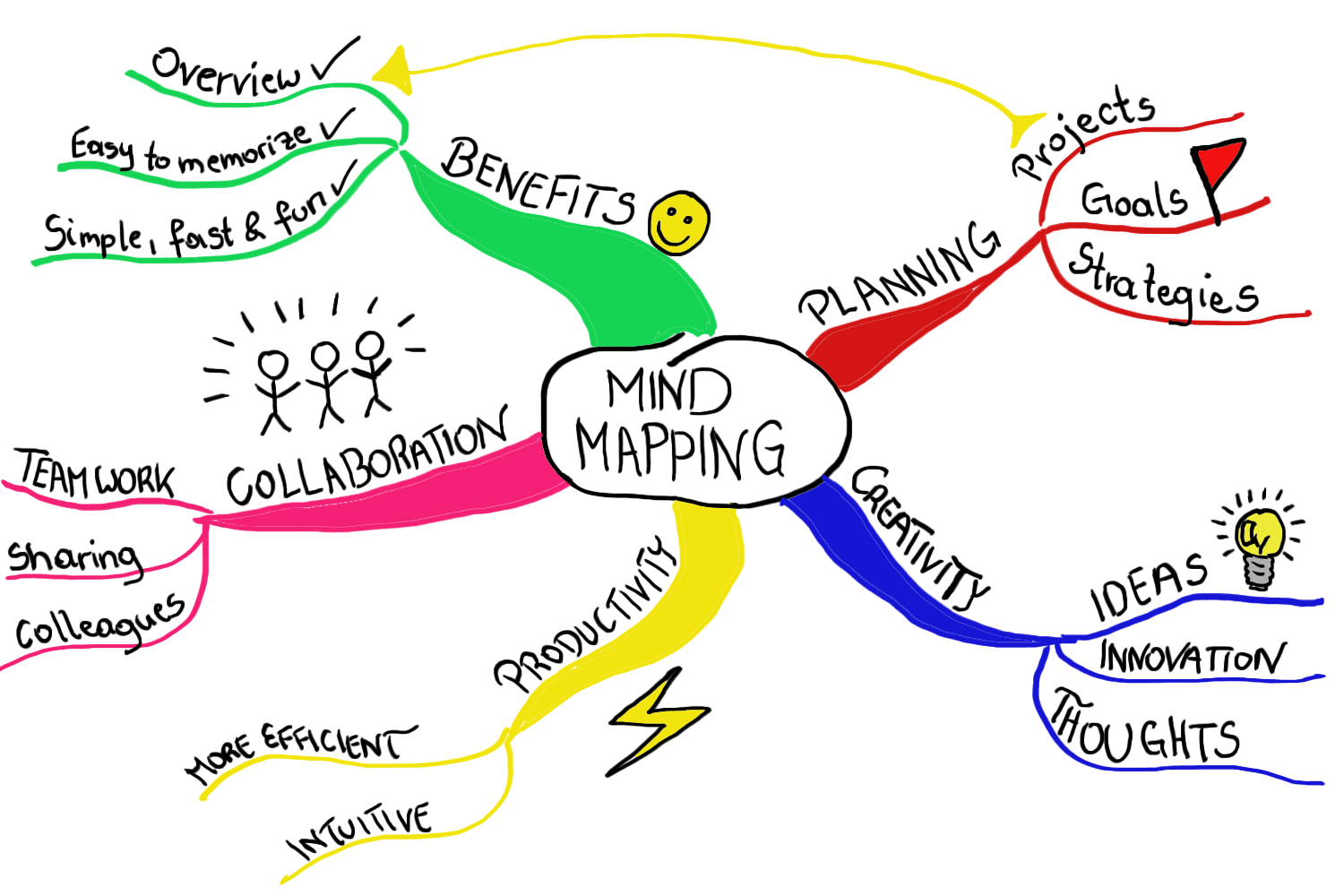 Research backs this up. A Johns Hopkins study found that students who use mind mapping can boost their grades by up to 12%. Separate research shows that including visual elements alongside text improves test scores by an average of 89% compared to text-only materials. And mind mapping has been shown to improve information retention by 10–15% versus traditional note-taking methods.
Here's why mind maps give students an edge:
They reflect how your brain works. A mind map's radial structure directly mirrors how our brains store and retrieve information — by association, not by rote.
They reveal the big picture. A mind map shows hierarchy and relationships between individual ideas, so you always know how the pieces fit together.
They use mental triggers. Colors, images, and visual connections help your brain memorize things more easily than plain text.
They make studying more engaging. Mind mapping doesn't feel like work — and that matters when you're hours into a study session.
Anyone can use mind maps, whether you're just starting high school or finishing a graduate degree.
"Mind maps utilize all our cortical skills and activate the brain on all levels, making it more alert and skillful at remembering." — Tony Buzan, The Mind Map Book.
How to create a mind map for school: 4 simple steps
Before diving into the examples, here's a quick-start process you can use for any mind map:
Step 1: Choose your central topic. Write the main subject — a chapter, concept, or assignment — in the center of a blank page or canvas.
Step 2: Add your main branches. Draw branches outward from the center, one for each major subtopic or category. Use single keywords or short phrases, not full sentences.
Step 3: Expand with sub-branches. From each main branch, add sub-branches for supporting details, examples, or questions. The more specific, the more useful your map becomes.
Step 4: Add visual cues. Use colors, icons, or simple sketches to make your map memorable. Color-coding different branches helps your brain quickly locate information when reviewing.
Want to go deeper? Check out our Mind Mapping 101 course for a full walkthrough.
You can start with pen and paper, but an online mind mapping tool like MindMeister gives you the flexibility to edit, share, and access your maps from any device — whenever inspiration strikes.
15 mind map examples for students
Use these 15 examples to find the right mind mapping approach for every situation in school — from daily homework to end-of-semester exam prep.
1. Brainstorming mind map
Mind mapping is one of the most effective brainstorming techniques available. When you need ideas for an essay, project, or any creative task, starting with a blank mind map and free-associating outward gets your creative thinking flowing faster than staring at a blank page.
Pro tip: If you run out of ideas mid-session, try drawing a few blank branches on purpose. Your brain dislikes unfinished structure and will naturally start filling in the gaps.
2. Note-taking mind map
Most students take notes in a traditional linear format. Mind maps, however, are a much more effective note-taking tool — especially during live lectures.
Instead of trying to transcribe everything your teacher says, a mind map compels you to actively process what you hear. Stick to essential keywords and meaningful images rather than full sentences. You'll save time during the lesson and when reviewing your notes later.
3. Memorization mind map
Mind maps can help you memorize everything from vocabulary and grammar rules to historical dates and scientific formulas. A great technique: hide individual branches of your map, then try to recall the hidden information before revealing it. Repeat this over time and the content becomes genuinely fixed in memory.
This works because mind maps engage multiple cognitive pathways at once — visual, spatial, and associative — making recall feel more natural and less effortful.
4. Reading comprehension mind map
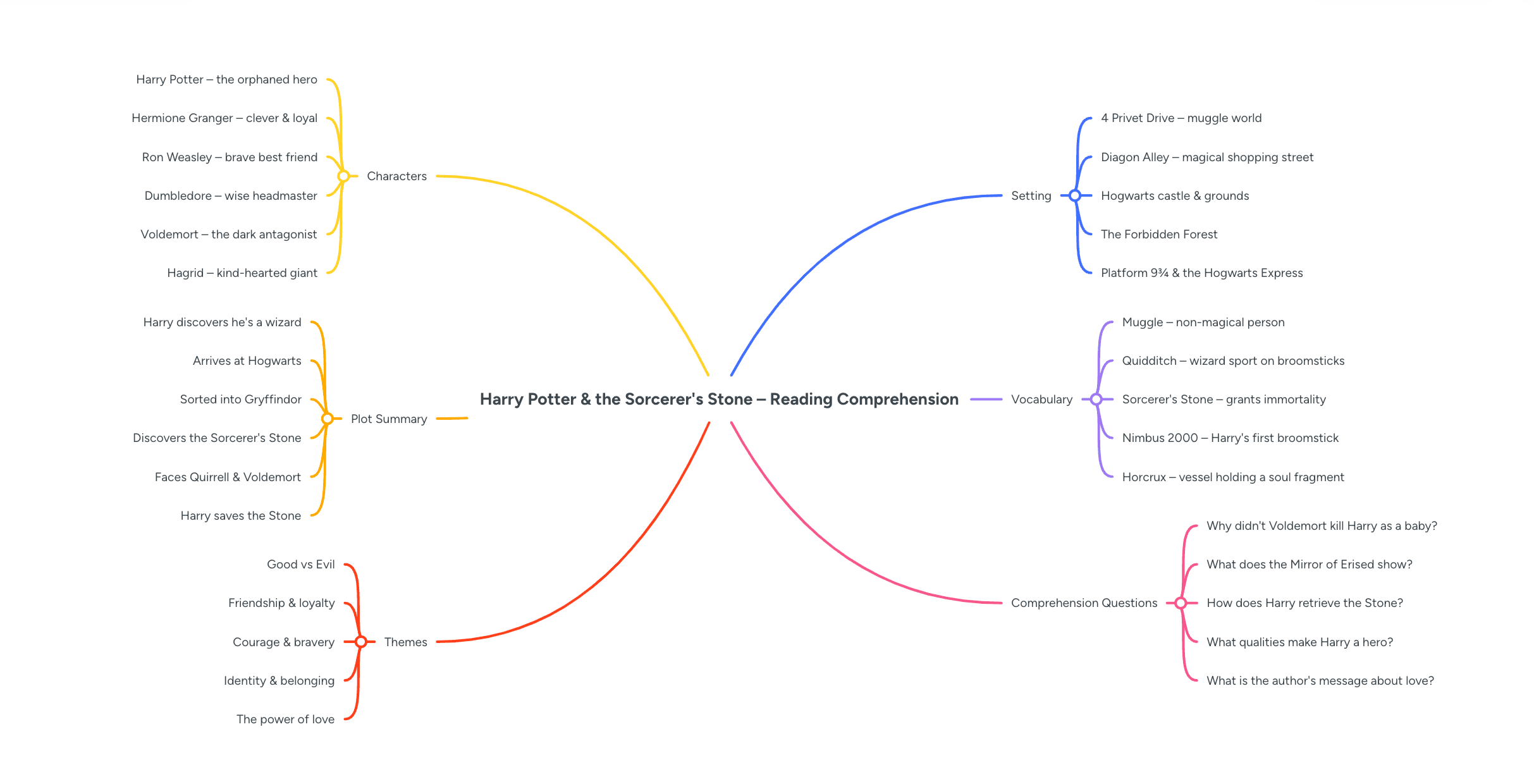
Complex academic texts — dense essays, scientific papers, historical documents — can be difficult to absorb on first reading. A reading comprehension mind map helps you break the text into manageable chunks, group related ideas, and flag unfamiliar terms as you go.
How to use it: As you read, note down unfamiliar words and open questions as branches. After finishing, research those terms and bring unresolved questions to class. Revisit the map before an exam as a quick refresher.
5. Group project mind map
Dreading group projects? A shared mind map makes collaboration significantly easier. An online group project mind map gives your whole team a shared visual overview of what needs to be done, who owns what, and how all the pieces connect.
With MindMeister, everyone can access and edit the same map simultaneously. On a paid plan, you can assign tasks to specific team members directly within the map and link files and resources right where they're needed.
6. Class presentation mind map
Instead of a traditional slideshow, consider presenting your next class report as a mind map. A visual map is often more engaging for an audience than a stack of bullet-point slides, and it lets you navigate non-linearly in response to questions.
MindMeister's presentation mode turns any mind map into a guided slideshow in just a few clicks. Check out the video below to see how to create a book report presentation in under three minutes.
7. Homework mind map
Never miss an assignment again. A homework mind map keeps all your tasks, deadlines, and reading materials organized in one visual overview. As you work through your list, check completed tasks off directly in the map — satisfying and effective.
This is especially useful at the start of a busy week when you need to quickly prioritize what's most urgent.
8. Essay mind map
Mind maps serve two key functions for essay writing: brainstorming your argument and organizing your research. Outline your essay's structure as main branches (introduction, body paragraphs, conclusion), then populate each branch with supporting arguments, quotes, and source references.
You can even draw connections between branches to show how different arguments relate to each other — something that's nearly impossible to do with a linear outline.
Want more inspiration? Check out our comprehensive guide to mind maps for essay writing.
9. Exam preparation mind map
Take the stress out of exam season. An exam prep mind map brings together everything you need in one place:
Class notes and lecture summaries
Relevant textbook chapters (and their comprehension maps)
Your reading list
Links to online study resources
Practical exam details: date, time, format, and what to bring
Having everything connected in a single visual overview means no more last-minute scrambling — you can review your whole preparation at a glance.
10. Semester plan mind map
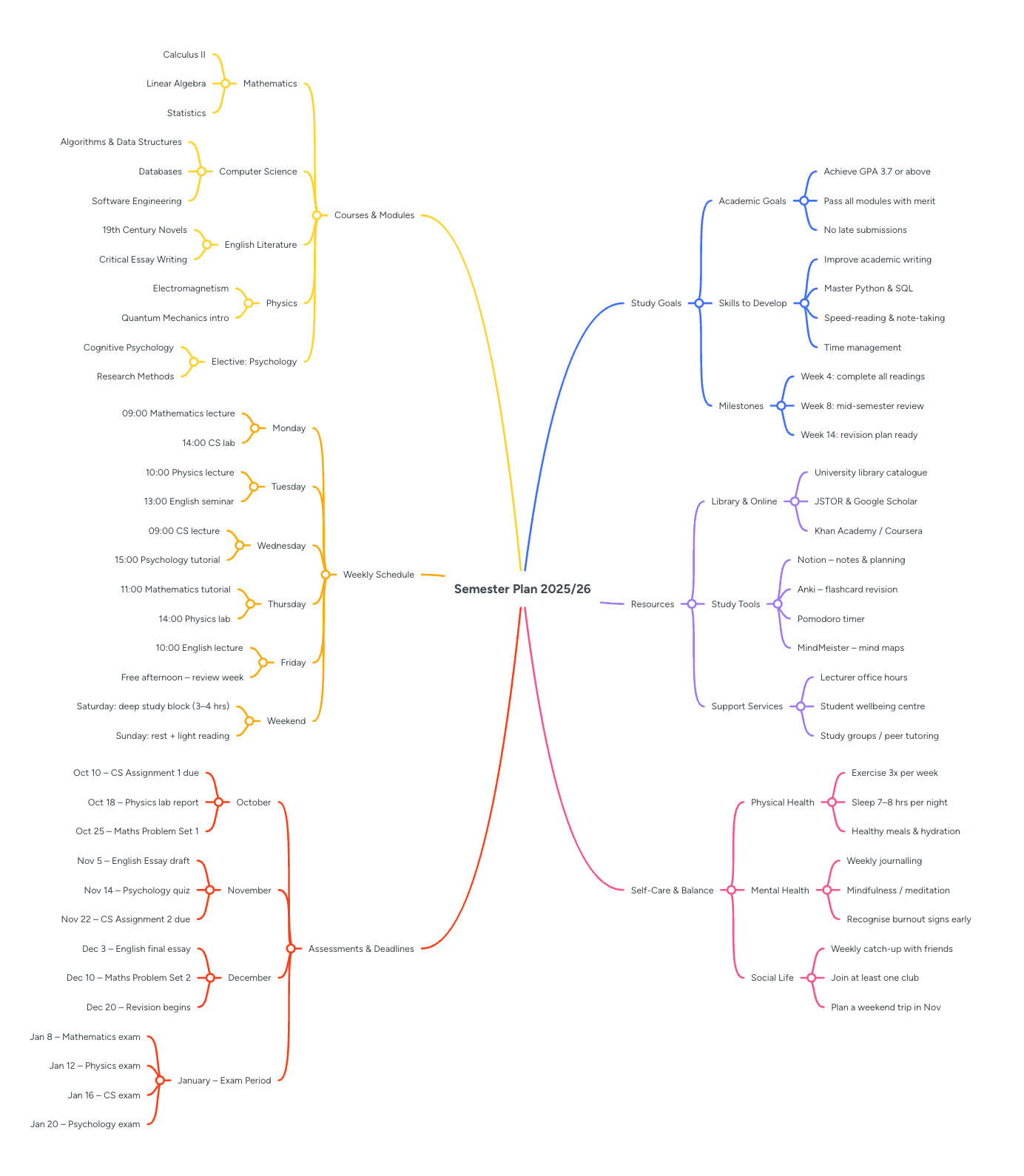
Keeping track of multiple classes, assignments, and deadlines across an entire semester is genuinely challenging. A semester plan mind map puts your full academic calendar in one place — all classes, key assignments, reading materials, and exam dates visible at a glance.
Link your syllabi, Google Docs, and worksheets directly into the map so everything is accessible from one location. Set deadlines per assignment and check them off as you complete them — just like the homework map, but at semester scale.
11. Creative writing mind map
Starting a short story assignment but not sure where to begin? Map it out first. Define your setting, characters, story arc, and key plot points as branches before you start writing. Add images or sketches to bring your characters to life visually.
Having your story mapped out means your mind is free to focus on the actual writing — not on trying to hold all the details in your head at once. This public MindMeister example is a great reference for how to structure a story map.
12. Lab report mind map
Science doesn't have to be purely text-based. If you want to make your lab reports more engaging (and easier to review before exams), try presenting your findings in a mind map format. This free lab report template is a great starting point — copy it directly to your MindMeister account and customize it for your experiment.
13. Grammar mind map
Learning a new language or brushing up on grammatical rules? A grammar mind map is one of the most effective ways to organize rules and their exceptions. Place a grammar concept at the center (e.g., "past tense"), then branch out into its different forms, common uses, and practical examples.
Because you're building a visual web of rules rather than a linear list, you'll find it easier to identify patterns — and to recall those patterns when you actually need them. Mind maps are an excellent tool on the path to learning a new language.
14. Business ideas mind map
Whether it's a class assignment or a side project you're passionate about, a mind map is one of the best tools for developing a business idea. Start with your core concept at the center, then branch out into product ideas, target audiences, marketing channels, and competitive landscape.
Once you've mapped the big picture, develop it further with a business brainstorming mind map like the one below.
15. School club mind map
Running a student club or organization involves a surprising number of moving parts — events, budgets, members, communication, logistics. A mind map gives you a central command view of everything.
Planning a club event? Create branches for the schedule, budget, and volunteer coordination. Going on a trip? Map out destination options, fundraising ideas, and transportation details. Share the map with all club members so the whole team can contribute and stay aligned.
Start mind mapping for free
Whether you're working with pen and paper or using an online tool, these 15 examples give you a solid foundation for getting started. MindMeister's free version lets you create and share mind maps right away — no credit card required. When you're ready for more, a paid educational plan unlocks unlimited maps, document attachments, task assignments, and export options (PDF, image, Word, PowerPoint).
Make learning easier — with MindMeister
FAQ | Frequently asked questions about mind maps for studying
A mind map is a visual diagram that organizes information around a central topic, with related ideas branching outward. It's useful for studying because it mirrors how your brain naturally stores information — through associations rather than linear sequences. Research shows mind mapping can improve retention by 10–15% compared to traditional note-taking.
The most versatile examples for school are the brainstorming map, note-taking map, essay map, and exam preparation map. For college students, semester planning maps and reading comprehension maps are particularly effective for managing heavy workloads and dense academic texts.
Start with your central topic in the middle of a blank page or canvas. Add main branches for each key subtopic, then expand each with sub-branches for supporting details. Use keywords rather than full sentences, and add colors or images to make your map more memorable. Tools like MindMeister make this process faster and easier with ready-made templates.
Yes. With MindMeister, you can create mind maps in a browser or mobile app, share them with classmates or teachers in real time, and export them as PDFs, images, or Word and PowerPoint files. A free plan is available, with additional features on paid educational plans.
For many students, yes — especially for topics that involve a lot of interconnected concepts. Mind maps are more visual, more engaging, and better at showing relationships between ideas than linear notes. That said, the best approach is often a combination: use mind maps for organizing and reviewing, and use linear notes when you need to capture detail quickly during a fast-paced lecture.