

What makes a strong thesis statement
A thesis statement is the one or two sentences, usually at the end of your introduction, that tell the reader what your essay argues and why it matters. Every paragraph that follows should support it. If a body paragraph doesn't connect back to your thesis, either the paragraph or the thesis needs to change.
The UNC Writing Center's thesis advice puts it simply: a thesis answers a question about your topic, and that answer is something a reasonable person could disagree with. That's the line between a thesis and a statement of fact.
Strong thesis statements share four traits:
Arguable: someone could reasonably take the opposite position. "Social media exists" isn't a thesis. "Schools should teach social media literacy as a required course" is.
Specific: it states a clear claim rather than a broad topic. "Climate change is bad" is a topic. "Coastal cities should stop issuing permits for new beachfront construction" is a claim.
Focused: it fits the length of your essay. A five-paragraph essay can't prove a claim about the entire history of medicine.
Supported: it previews reasons you can back up with evidence from your sources, not opinions you can only repeat.
A quick test: read your thesis and ask "so what?" and "how do you know?" If the sentence already hints at both answers, you're in good shape.
Thesis statement template
When you're stuck on a blank page, a formula gets you to a first draft fast. Most strong thesis statements follow this pattern:
[Topic] + [your claim] + because [reason 1], [reason 2] and [reason 3].
For example: "Public libraries (topic) are more important now than they were 20 years ago (claim) because they offer free internet access, provide quiet study space for students without one at home and run programs that reduce social isolation (reasons)."
You can also use a shorter version that leaves the reasons for the body paragraphs:
Although [counterargument], [your claim] because [main reason].
For example: "Although standardized tests are easy to compare across schools, colleges should drop them as an admissions requirement because they measure access to test prep more than academic ability."
Treat the template as scaffolding. Once your argument takes shape, rewrite the sentence so it sounds like you, not like a fill-in-the-blank form.
Thesis statement examples by essay type
The right thesis depends on what your essay is asked to do. Below are examples for the five essay types you'll write most often in high school and college, each with a weak version and a revised one.
Argumentative thesis statement examples
An argumentative essay takes a clear position on a debatable issue and defends it against the other side.
Weak: "Homework is a controversial topic in schools."
Strong: "Elementary schools should replace daily homework with 20 minutes of free reading, because research on young students shows little academic benefit from worksheets and real costs to family time and sleep."
Weak: "There are pros and cons to a four-day school week."
Strong: "Rural districts should adopt a four-day school week, because it cuts transportation costs, helps attract teachers and gives students a weekday for jobs and appointments."
Strong: "Cities should make public transit free for residents under 18, because it widens access to jobs and school activities and builds lifelong transit riders."
Analytical thesis statement examples
An analytical essay breaks a text, event or idea into parts and explains how they work together.
Weak: "The Great Gatsby has a lot of symbolism."
Strong: "In The Great Gatsby, Fitzgerald uses the green light, the valley of ashes and Gatsby's parties to show that the American Dream rewards appearance over substance."
Strong: "The opening scene of Macbeth establishes a world where loyalty and ambition can't coexist, a conflict that drives every major decision Macbeth makes."
Expository thesis statement examples
An expository essay explains a topic without arguing for one side. The thesis still needs a clear focus.
Weak: "This essay is about how vaccines work."
Strong: "Vaccines train the immune system in three stages: recognizing a harmless version of a pathogen, producing antibodies against it and storing memory cells for future protection."
Strong: "The Erie Canal changed the US economy by cutting freight costs, shifting trade toward New York City and speeding settlement of the Great Lakes region."
Compare and contrast thesis statement examples
A compare and contrast essay looks at two subjects side by side and explains what the comparison reveals.
Weak: "Remote learning and classroom learning are similar in some ways and different in others."
Strong: "Remote learning and classroom learning both cover the same curriculum, but classroom learning does a better job of building the social skills younger students need."
Strong: "Although both Frederick Douglass and Booker T. Washington championed Black advancement, Douglass demanded immediate equality while Washington argued for gradual economic progress."
Persuasive thesis statement examples
A persuasive essay is close to an argumentative one, but it leans more on appeals to the reader's values and calls for action.
Weak: "People should recycle more."
Strong: "Every high school should ban single-use plastic in its cafeteria, because students can lead the habit change that their communities need."
Strong: "Teenagers should be allowed to vote in local elections at 16, because the decisions made by school boards and city councils shape their daily lives more than anyone else's."
How to write a thesis statement in 4 steps
Examples help, but your own thesis has to come from your own thinking. These four steps take you from an assignment prompt to a working thesis.
Step 1: Turn the prompt into a question
Most prompts hide a question. "Discuss the role of social media in the 2020s" becomes "Has social media done more harm or good for teenagers in the 2020s?" Your thesis is your answer to that question.
Step 2: Write a rough answer
Draft one sentence that answers the question, even if it's messy. "Social media has hurt teens more than it helped" is a fine start. You'll sharpen it later.
Step 3: Ask why, and list your reasons
Under your rough answer, list every reason you can think of. Then circle the two or three you can support with real evidence from your reading. Those become your body paragraphs, and they belong in your thesis.
Step 4: Revise for precision
Replace vague words like "good," "bad," "things" and "society" with specific ones. Check that your thesis is arguable, specific and focused. Then read it out loud. If it takes two breaths, it's probably trying to do too much.
Expect your thesis to change as you write. A working thesis is a starting point, and it's normal to come back and revise it after your first draft shows you what you're really arguing.
Building your thesis as a mind map in MindMeister
A thesis statement is only as strong as the reasons and evidence underneath it. Writing it as a single sentence hides that structure. A mind map makes it visible, so you can see weak spots before you start drafting.
Here's how to lay out a thesis in MindMeister:
Central topic: put your working thesis in the center of the mind map.
Main branches: add one branch for each reason. Three reasons usually mean three body paragraphs.
Sub-branches: under each reason, add the evidence that supports it: quotes, data, examples from your reading.
Notes and links: attach page numbers, source links and short notes to each piece of evidence, so you're not hunting for citations later.
Counterargument branch: add a separate branch for the strongest objection to your thesis and how you'll respond to it.
Here's what that looks like for the four-day school week thesis from the examples above:
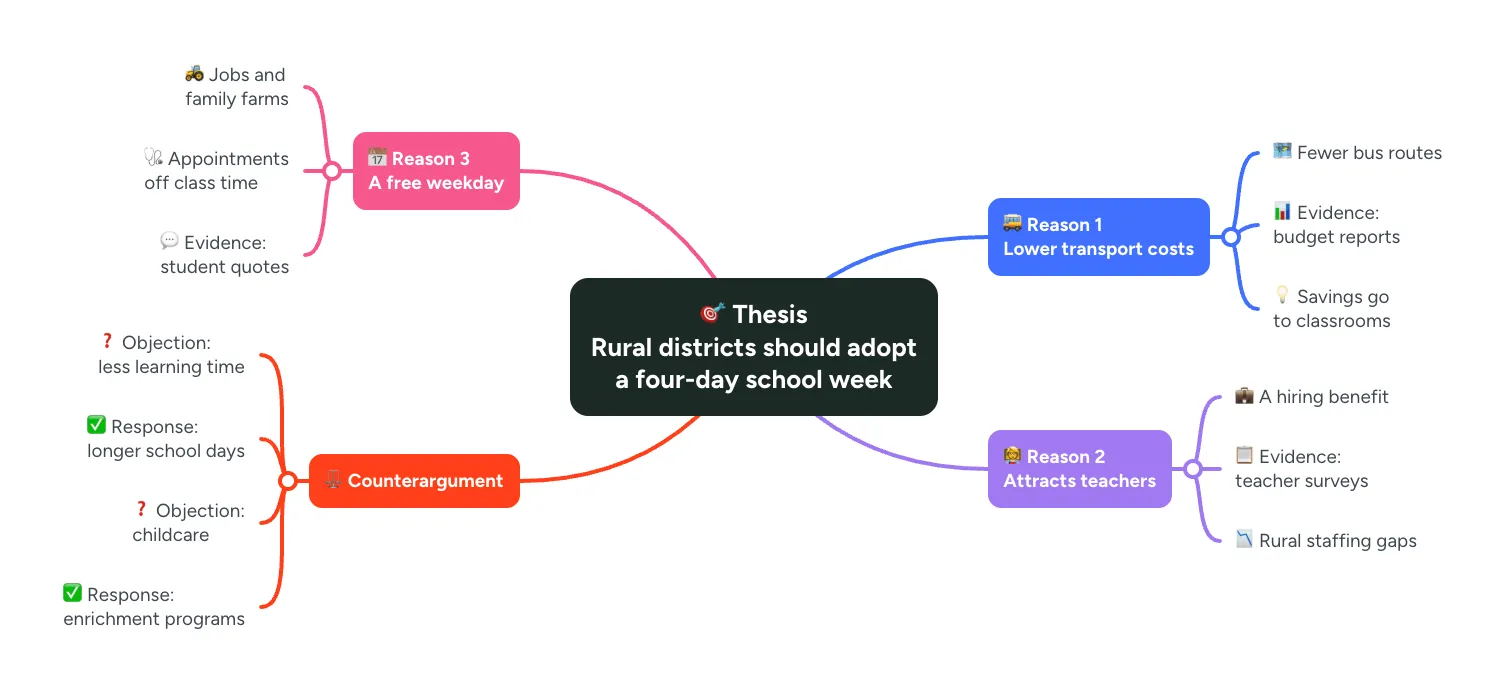
Now look at the whole mind map. A reason with only one thin sub-branch needs more research, or it needs to go. A piece of evidence that doesn't clearly support its branch belongs somewhere else. If your branches drift away from the central topic, your thesis is too broad.
Once the mind map holds together, the essay almost outlines itself. The central topic becomes your thesis, the main branches become your topic sentences and the sub-branches become the evidence in each paragraph. This is the same approach that works for planning and writing better essays, and it scales up for longer assignments, too. For a full step-by-step walkthrough, see our article on mind maps for essay writing. And for papers with many sources, the same structure becomes a research paper outline with sections rather than paragraphs.
If you're juggling several essays at once, it helps to turn the next steps into a plan. Add each step, from research to first draft to final edit, as a task with a due date in MeisterTask. When you track your writing deadlines on one board, a mind map full of ideas turns into finished work on time.
Revising a weak thesis: a before and after
Seeing a thesis change step by step makes the process easier to copy. Here's one working thesis for a history class, revised three times.
Draft 1: "The Industrial Revolution changed a lot of things." This is a topic, not a claim. Nobody would disagree, and "a lot of things" gives the reader nothing to follow.
Draft 2: "The Industrial Revolution changed family life in England." Better, because it narrows the scope to one place and one area of life. But it still doesn't explain how, so the essay lacks direction.
Draft 3: "The Industrial Revolution weakened the family as an economic unit in England, because factory work separated parents from children for most of the day and paid each family member a separate wage." Now the thesis is arguable, specific and focused, and it previews two body paragraphs.
Notice what changed between drafts. Each revision answered a question a reader might ask: Where? Which part of life? How exactly? If your own thesis feels flat, ask those same questions and let the answers do the rewriting.
Common thesis statement mistakes
Even strong writers fall into the same traps. Watch for these when you review your draft:
Announcing instead of arguing: "In this essay, I will discuss..." tells the reader what you'll do, not what you think. Cut the announcement and state the claim.
Stating a fact: "The US entered World War II in 1941" is true, so there's nothing to argue. Ask what the fact means or why it matters.
Asking a question: a thesis answers a question. It doesn't pose one.
Going too broad: "Technology has changed the world" could fill a library. Narrow it to a specific technology, group and effect.
Listing reasons you can't support: every reason in your thesis needs evidence in your essay. If you can't find sources for one, drop it.
Hiding the thesis: put it where readers expect it, at the end of your introduction, unless your teacher asks for a different structure.
A clear thesis makes the rest of your essay easier to write. Start with the template, test it against the examples above and lay out your reasons and evidence in a mind map before you draft. You'll spend less time rewriting and more time making your argument land.
Lay out your thesis and evidence in one view