

What strategic planning means
So what is strategic planning in plain terms? It is the process of choosing a clear direction for your organization and deciding how to pursue it. FranklinCovey frames it as defining where an organization is going and how it will get there. You then turn that direction into a plan with priorities, timelines and owners.
Every strategic plan answers 3 questions:
Where are you now? An honest view of your market, team, results and resources.
Where do you want to be? A clear destination with goals for the next 1 to 3 years.
How do you get there? The priorities, owners and timelines that move you forward.
Strategic planning differs from operational planning in scope. Strategic planning sets direction across months or years, while operational planning organizes the daily and weekly work that executes it. For example, "win 3 mid-market clients this year" is strategic, while "send the Q2 newsletter" is operational. The process works at any size: A 5-person startup benefits as much as a 500-person company.
Keep your expectations honest. A plan gives you direction and priorities, but it does not predict the future. Think of it like a planned route: The destination stays fixed while you reroute around road closures. The 5 steps below show you how to plot that route.
The strategic planning process in 5 steps
The strategic planning process works best when each step builds on the last. To make it concrete, follow a 40-person marketing agency as it plans its next 12 months. Each step adds a new layer to 1 shared mind map, so the whole team sees the full plan in 1 place. You can follow the same sequence with your own team.
1. Assess the current state
Start with an honest look at where you stand today. A SWOT analysis covers your internal strengths and weaknesses plus the external opportunities and threats around you. If you want a refresher, read the article on how to run a SWOT analysis before your workshop. For the agency, the picture looks like this:
Strength: a base of retained clients in 1 vertical
Weakness: founder-dependent sales
Opportunity: demand for AI-assisted content services
Threat: in-house teams cutting agency budgets
In MindMeister, build this as a 4-branch mind map with 1 branch per SWOT quadrant. Add notes under each branch so the evidence stays next to the insight. You can also chart your stakeholders in a separate mind map before planning, so you know whose input each branch needs. Make each point specific enough that someone outside the team could check it.
2. Define the vision and long-term goals
Next, decide where you want to be. Write your vision in the central node of the mind map and keep the SWOT branches nearby as context. Then add 3 to 5 main branches, 1 for each goal over the next 1 to 3 years. Aim for 1 short sentence the whole team can repeat.
The agency writes its vision as "The go-to content partner for B2B software brands." It then adds 3 goal branches. The agency wants to grow its share of retainer revenue, launch an AI-assisted content service and make sales less dependent on the founder. Each goal sits on its own branch, so progress stays visible at a glance.
Keep your goals few and specific. Vague goals like "grow the business" give your team nothing to act on. If you want a structure for writing sharper goals, use this goal setting template for strategic priorities.
3. Identify strategic priorities
Not every goal can get your attention at once. Under each goal branch, add sub-branches for the initiatives that could advance it. Then rank each initiative by impact and feasibility. The highest-ranked initiatives become your strategic priorities.
Say the agency lists 9 initiatives across its 3 goals. After ranking, 3 make the cut: hiring a dedicated salesperson, packaging an AI-assisted content offer and turning 2 retained clients into case studies. The other 6 stay in the mind map as parked ideas, so nothing gets lost.
Big shifts, like a new service line, often face resistance within the team. Run a force field analysis before a major strategic shift to weigh the forces that help or block each priority. This step keeps your plan focused on the few bets that matter most. Hold the list to a handful, because a plan with 10 priorities has none.
4. Assign ownership and timelines
A priority without an owner tends to drift. Give each priority branch 3 sub-branches: the responsible person or team, key milestones and a target completion date. Name 1 person per priority so accountability stays clear, even when a whole team does the work.
For the agency's sales priority, the owner is the operations director. The milestones are a signed job offer by March and 10 new leads from the new hire by June. The target completion date is Sept. 30. Anyone who opens the mind map sees who owns what and when it is due.
In MindMeister, you can turn priority branches into MeisterTask tasks to track execution. The built-in MeisterTask integration keeps your plan and your daily work connected. The mind map holds the why, while the tasks hold the daily how.
5. Set a review cadence
Add a "Review" branch to your mind map with dated sub-branches for each check-in. Put the dates in the branch names so nobody misses a review. A quarterly rhythm works well for many teams. It comes often enough to catch change and leaves enough time between check-ins to show real progress.
Each review does 3 jobs. You check progress against milestones, update priorities based on what changed and adjust the plan to match. Write the decisions into the dated sub-branch so the next review starts from facts.
Even in stable markets, revisit your plan at least once a year. The Hartford recommends this yearly minimum, with more frequent reviews in fast-moving industries. Your market sets the pace, so choose the rhythm your team can keep.
A strategic plan example built as a mind map
This strategic plan example follows a SaaS company whose central node reads "Expand into mid-market segment by Q4 2027." Its main branches cover the vision, a current state assessment, 3 strategic priorities, ownership and the review cadence. The vision branch sets the destination: the default tool for mid-market teams in its category. The other branches break down like this:
Current state assessment: a SWOT summary with 4 sub-branches for strengths, weaknesses, opportunities and threats
Priority 1 (product readiness): SSO, admin controls and audit logs, owned by the product lead, with a beta by Q1 2027
Priority 2 (sales capacity): 2 mid-market account executives and a mid-market pricing tier, owned by the head of sales, by Q2 2027
Priority 3 (market proof): 3 mid-market case studies and a customer webinar series, owned by the marketing lead, by Q3 2027
Ownership: a summary of every owner, with the milestones and target dates for each priority
Review cadence: quarterly check-ins on Jan. 15, April 15, July 15 and Oct. 15, 2027
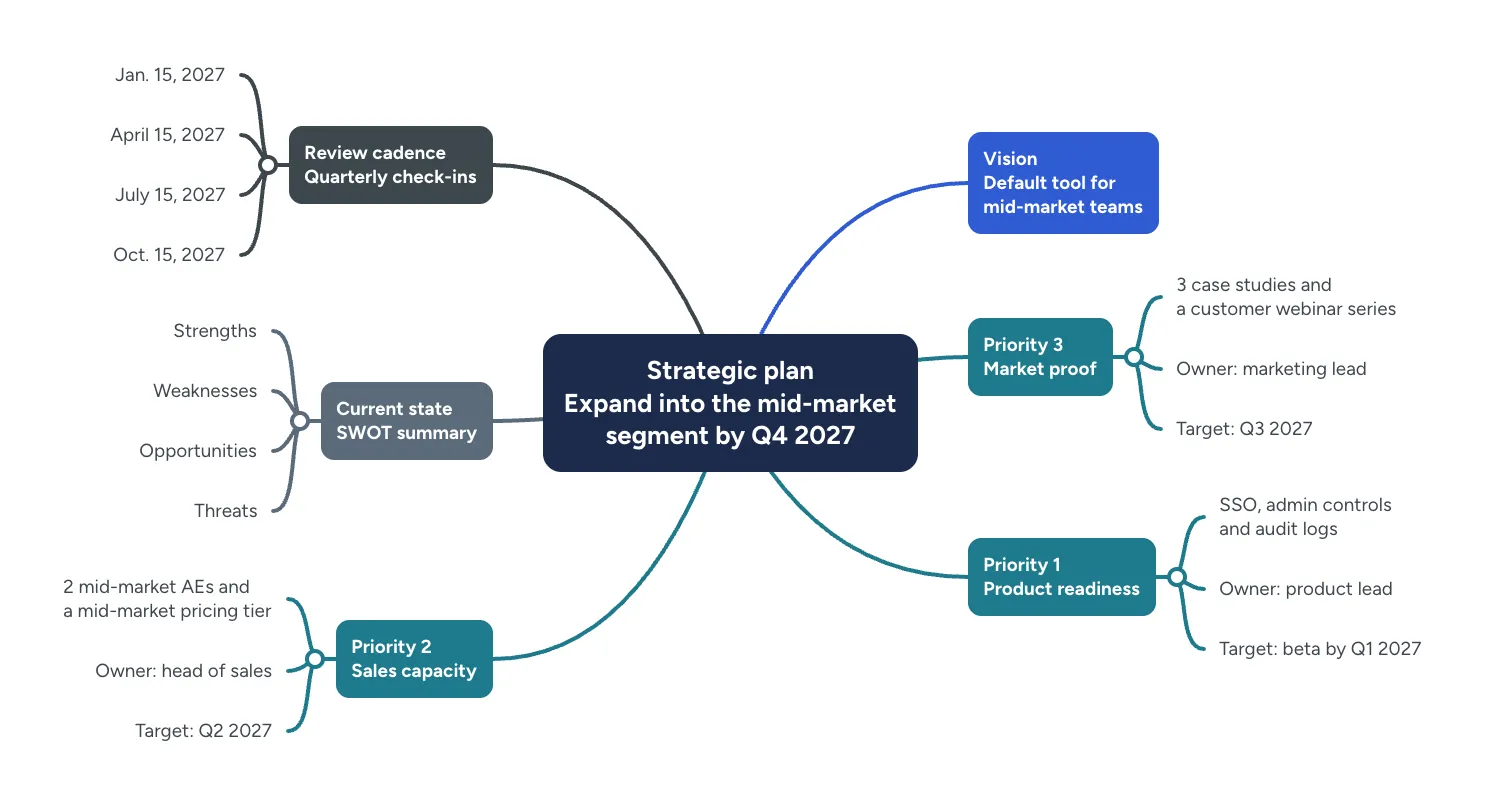
To build your own version in MindMeister, start from a blank mind map or adapt the strategic planning use-case templates. Collapse every branch except the 1 under review to keep each check-in focused. With real-time collaboration, each owner updates their branch during the meeting, while the team watches the plan change in real time. Attach docs to any branch so the evidence sits next to the decision.
Once the mind map is complete, share it with every priority owner and invite them to comment directly on their branches. Questions and objections then surface while the plan is still easy to change, not halfway through the quarter. Before the first quarterly review, ask each owner to update their own branch with the current status, so the meeting starts with an accurate picture instead of a round of status reports. Over time, the mind map becomes the single place where the team checks what was decided, who owns it and how far it has come.
Common strategic planning mistakes
Most strategic plans fail in execution, not in the workshop. Watch for these patterns when you build and review yours:
Too many priorities: if everything is a priority, nothing is. Cut the list until each priority has the people and budget it needs.
No owners: a priority that belongs to "the team" belongs to no one. Name 1 person per priority, even when many people do the work.
Goals without measures: "improve customer satisfaction" can't be tracked. Add a number and a date so you know when you're done.
Planning in isolation: a plan written by leadership alone often misses what the people closest to customers already know. Invite input early.
Set and forget: a plan that never gets reviewed drifts away from reality within a quarter. Put the review dates in the calendar before the planning session ends.
A shared mind map helps with most of these. When the whole plan sits on 1 page, missing owners, vague goals and overloaded branches are easy to spot.
Strategic planning vs strategy: the difference
You might hear strategy and strategic planning used interchangeably. They are related, but each plays a distinct role in how your organization moves forward. Here is the short version:
Strategy: the set of choices about where to play and how to win (your direction)
Strategic planning: the process of making those choices, documenting them and turning them into an actionable plan (your process)
A startup can have a clear strategy without a written plan. A large company can run a thorough planning process and still end up with a weak strategy. Without a plan, direction can stay in a few heads and never reach the wider team. The best outcome combines both: clear direction from a structured process, written down in a plan your team executes against.
This article focuses on the planning process and how to turn direction into a working plan.
Ready to close the gap between ambition and execution? Open a blank mind map in MindMeister and follow the 5 steps above. If you want a head start, begin with the strategic planning use-case page and adapt the example mind map to fit your team. Your plan grows 1 branch at a time, along with your team's shared picture of where you're headed.
Turn your strategy into an actionable plan