
What is a SWOT analysis?
A SWOT analysis is a strategic planning tool that helps you identify internal strengths and weaknesses alongside external opportunities and threats. It gives you a structured way to look at where your organization stands today and what might shape its future.
The exercise is fact-based and data-driven.
It's used to assess a company's competitive position and plan ahead, but it works just as well for a single product, a department, a nonprofit, a government body, or even a personal career plan.
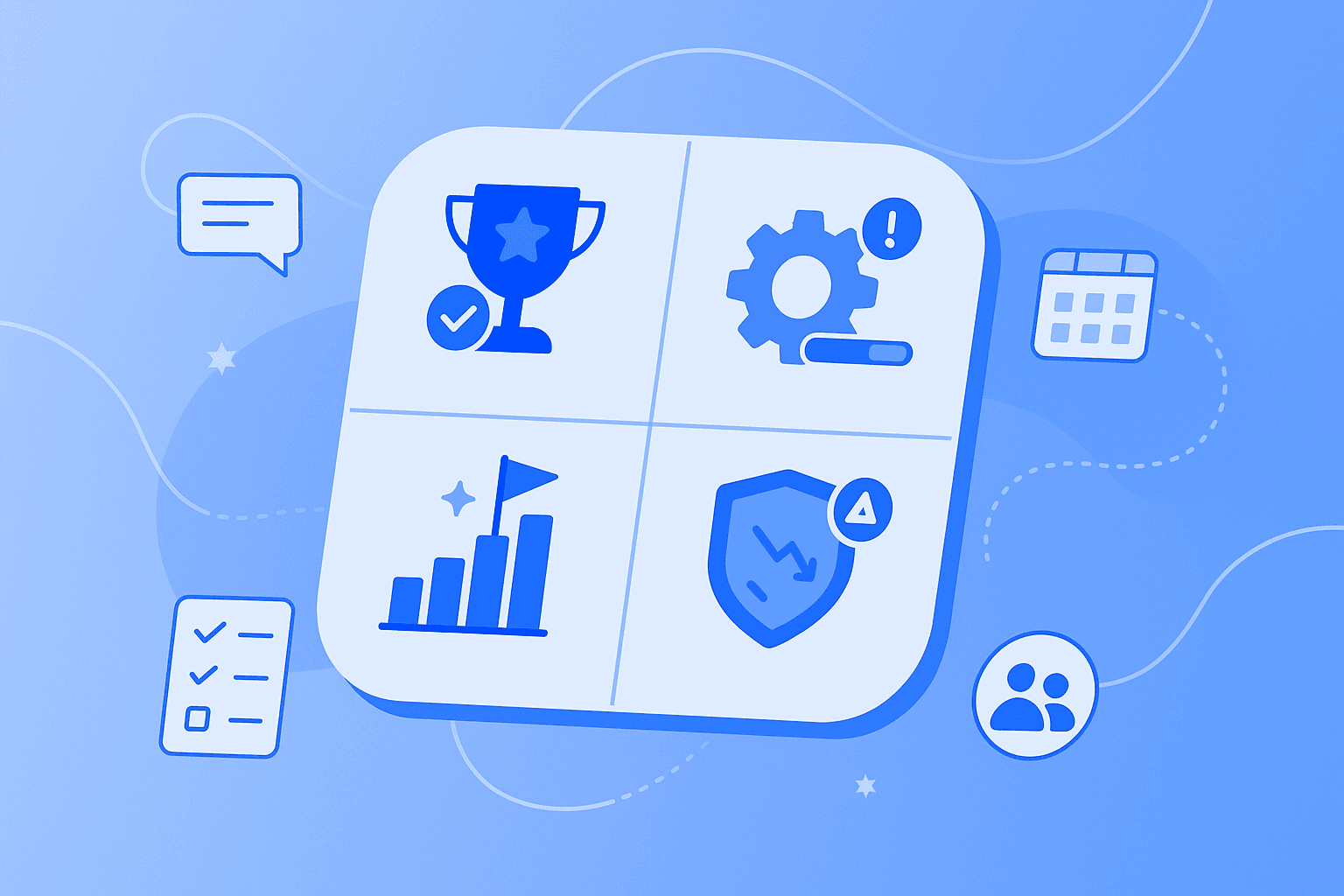
SWOT stands for Strengths, Weaknesses, Opportunities and Threats. Each quadrant tells you something different about your situation, and together they paint a full picture of where you are and where you could go next.
Why run a SWOT analysis?
A SWOT analysis helps you step back and see the bigger picture before making big decisions. It's one of the simplest planning tools out there, and it's used by teams of every size — from a two-person startup to a global enterprise.
Here's what you get out of running one:
Simplifies complex decisions: SWOT helps you see internal capabilities and external conditions side by side in one place.
Improves strategic planning: it forces you to weigh what you control against what you don't.
Encourages diverse input: gathering perspectives from multiple stakeholders leads to more realistic findings.
Identifies blind spots: looking at threats and weaknesses helps you prepare for challenges you might otherwise miss.
Teams that revisit and update their SWOT regularly tend to make better decisions and spot risks earlier. The trick is treating it as a living reference, not a one-off slide in a deck.
The 4 SWOT quadrants explained
The four parts of a SWOT fall into 2 groups — internal factors you can control and external factors you can't. Keeping that distinction clear is what makes the tool useful instead of just a list.
Strengths (internal)
Strengths are what your organization does well or where it has an advantage. Think of a strong brand reputation, a loyal customer base, proprietary technology, a skilled team, or solid financials. These are the assets you build on when planning your next move.
Weaknesses (internal)
Weaknesses are the areas holding your organization back. Common examples include weak brand recognition, high debt, outdated processes, supply chain issues, or a lack of capital. Naming them honestly is the first step toward fixing them.
Opportunities (external)
Opportunities are favorable outside conditions you could benefit from. They might include emerging markets, new technology, regulatory changes, competitor weaknesses, or shifting customer preferences. Spotting them early gives you a head start over slower-moving competitors.
Threats (external)
Threats are external risks that could harm your business. Rising costs, stronger competition, labor shortages, an economic downturn, or new regulations all fall into this group. You can't stop them, but you can plan for them.
The split matters. Strengths and weaknesses are things you can change, while opportunities and threats are things you respond to but can't directly shape.
How to run a SWOT analysis step by step
A SWOT analysis works best when it's collaborative and structured. The 6 steps below will help you gather input, organize findings and turn insights into action your team can follow through on.
1. Set your objective
Before any brainstorming, agree on what you're analyzing and why. Are you looking at the whole business, a specific product, a new market, or an upcoming project?
A clear objective keeps the conversation focused and stops it from drifting. For example, if you're launching a new product, your objective might be: "Assess our readiness to enter the European market with Product X by Q3."
Write the objective down and share it before the session starts so everyone arrives on the same page.
2. Gather background data
A good SWOT is built on facts, not gut feelings. Before the team meets, pull together the information that will shape the conversation:
Market research
Customer feedback
Financial reports
Competitor analysis
Industry trends
This prep work keeps the brainstorming grounded. Without it, the conversation slides into opinion and guesswork, and you end up with a SWOT that looks neat but isn't accurate.
3. Brainstorm strengths and weaknesses
Now you focus inward, on what's happening inside your organization. Invite a mix of voices — leadership, frontline staff, sales, marketing, and operations. Each group sees a different side of the business, and you want all of them on the map.
A few guiding questions can spark the discussion:
What do we do better than our competitors?
What resources or capabilities give us an edge?
Where do we struggle or fall short?
What processes or skills are we missing?
Honesty matters here.
Teams often overstate strengths and underplay weaknesses, which leads to a skewed picture and shaky plans. Encourage candid, fact-based input—and remind everyone that naming a weakness is the first step toward addressing it. Using a collaborative tool like MindMeister lets everyone contribute ideas in real time, so quieter voices aren't drowned out.
4. Explore opportunities and threats
Next, shift the conversation outward. This step focuses on the conditions shaping the world your business operates in, and the same guiding questions work well:
What market trends are emerging that we could act on?
Are there gaps our competitors haven't filled?
What external risks could disrupt our plans?
Are there technological or cultural shifts we should prepare for?
Diverse perspectives matter even more here.
5. Organize findings in a SWOT analysis template
Once you've collected input, organize everything into the classic four-quadrant layout: Strengths (top left), Weaknesses (top right), Opportunities (bottom left), and Threats (bottom right). The grid makes it easy to compare internal vs. external and positive vs. negative at a glance.
You can use a SWOT analysis template in a spreadsheet, a slide deck, or — for a more flexible, collaborative approach — a visual mind map in MindMeister. A mind map gives your analysis room to grow rather than locking it into fixed rows and columns. A few reasons that work well:
Keeps the analysis alive: your team can keep adding ideas after the meeting ends.
Shows connections: you can link related concepts across quadrants.
Surface patterns: it's easier to see relationships visually than in a table.
Stays shared: everyone can access and edit it in real time.
If you're starting from scratch, browse MindMeister's mind map examples and templates to find a structure that fits. Pick one and adapt it to your team's context.
6. Prioritize and turn insights into action
After the map is organized, prioritize. Not everything in your SWOT carries the same weight, and trying to act on every item at once is a fast way to stall. Ask:
Which strengths give us the biggest competitive advantage?
Which weaknesses pose the greatest risk?
Which opportunities are most aligned with our goals?
Which threats are most urgent or likely?
A simple method works well: star high-priority items, color-code them, or move them to the top of each quadrant. Then translate those priorities into concrete actions:
Strengths: how can you use these to pursue opportunities or offset threats?
Weaknesses: what steps will reduce or close them?
Opportunities: what projects will help you act on them?
Threats: how can you prepare for or soften the impact?
Your team walks away with a list of clear, assigned tasks — not just a filled-in template. Creating those tasks directly from your SWOT map in MindMeister keeps insights from getting stuck on the page.
Common SWOT mistakes (and how to avoid them)
A SWOT analysis is only as useful as the thinking behind it. Watch out for these common traps:
Being too optimistic or subjective: ground your analysis in data and invite candid feedback from a mix of stakeholders.
Excluding key voices: include people from different roles and levels, not just leadership.
Failing to prioritize: use a simple ranking or voting system to focus on what matters most.
Treating it as a one-time task: schedule regular updates and link findings to ongoing projects.
Avoiding these pitfalls makes your SWOT far more actionable. Teams that revisit their analysis quarterly — or after major changes — stay better prepared to adapt when conditions shift.
Bring your findings to life with collaborative tools
A SWOT analysis is most valuable when it's collaborative, visual, and regularly updated. A static table tucked into a slide deck rarely gets opened again, while a shared map invites your team back in.
With MindMeister, you can:
Brainstorm and organize findings in real time.
Keep the analysis editable and accessible over time.
Link insights to tasks, goals, and decisions.
See patterns and connections visually.
Browse SWOT analysis examples in MindMeister to see how different teams have structured their findings, then adapt one for your own.
Ready to try it with your team? Pick a goal, invite your team, and turn your next planning session into something you'll actually come back to.
Turn SWOT insights into action with MindMeister