


Why passive revision does not work
Re-reading your notes feels like a good revision technique. It is not. When you read something you already wrote down, your brain recognises it as familiar and mistakes familiarity for understanding. You close the textbook feeling confident, sit down in the exam, and find the information is not there when you need it.
Cognitive science has a name for this: the illusion of competence. The solution is not to read more carefully. It is to change the format entirely. Instead of reviewing what you wrote, test yourself on what you know. Instead of reading your notes in order, rebuild them from memory. Instead of treating every topic equally, focus your time on the gaps.
A mind map revision session forces all three of these shifts at once. You cannot copy a mind map passively. You have to decide where every idea belongs, which topics connect, and what belongs under each branch. That decision-making process is active learning, and active learning builds the kind of memory that holds up under exam pressure.
How to build a GCSE revision mind map
GCSE revision covers a lot of ground. Typically, eight to ten subjects, each with multiple topics, all coming to a head in a concentrated exam window in May and June. The biggest challenge is not learning any single topic. It is keeping the whole picture in view without letting any subject fall behind.
A mind map handles this at two levels. At the subject level, you build one map per subject with the subject name at the centre and each major topic as a main branch. Under each branch, you add sub-branches for the key concepts, definitions, processes, and examples that topic contains. At the exam level, you build one map for your full revision schedule with each subject as a main branch, your exam dates as nodes, and your remaining revision sessions distributed across the topics that need the most work.
Here is how to build your first GCSE revision map in MindMeister:
Open a blank map and type the subject name in the central node. For example, "GCSE Biology."
Add one main branch for each topic in your specification: Cell Biology, Genetics, Ecosystems, and so on.
Under each topic branch, add sub-branches for the key concepts you need to know. Use keywords, not full sentences.
Colour-code by confidence: green for topics you know well, amber for topics you are unsure about, red for topics you still need to cover properly.
Close the map and try to rebuild it from memory on a blank map. The branches you cannot reconstruct are the ones to prioritise in your next revision session.
The map below shows what a GCSE Biology revision map looks like in MindMeister, with four topic branches, colour-coded confidence nodes and spaced revision sessions under the exam date branch.
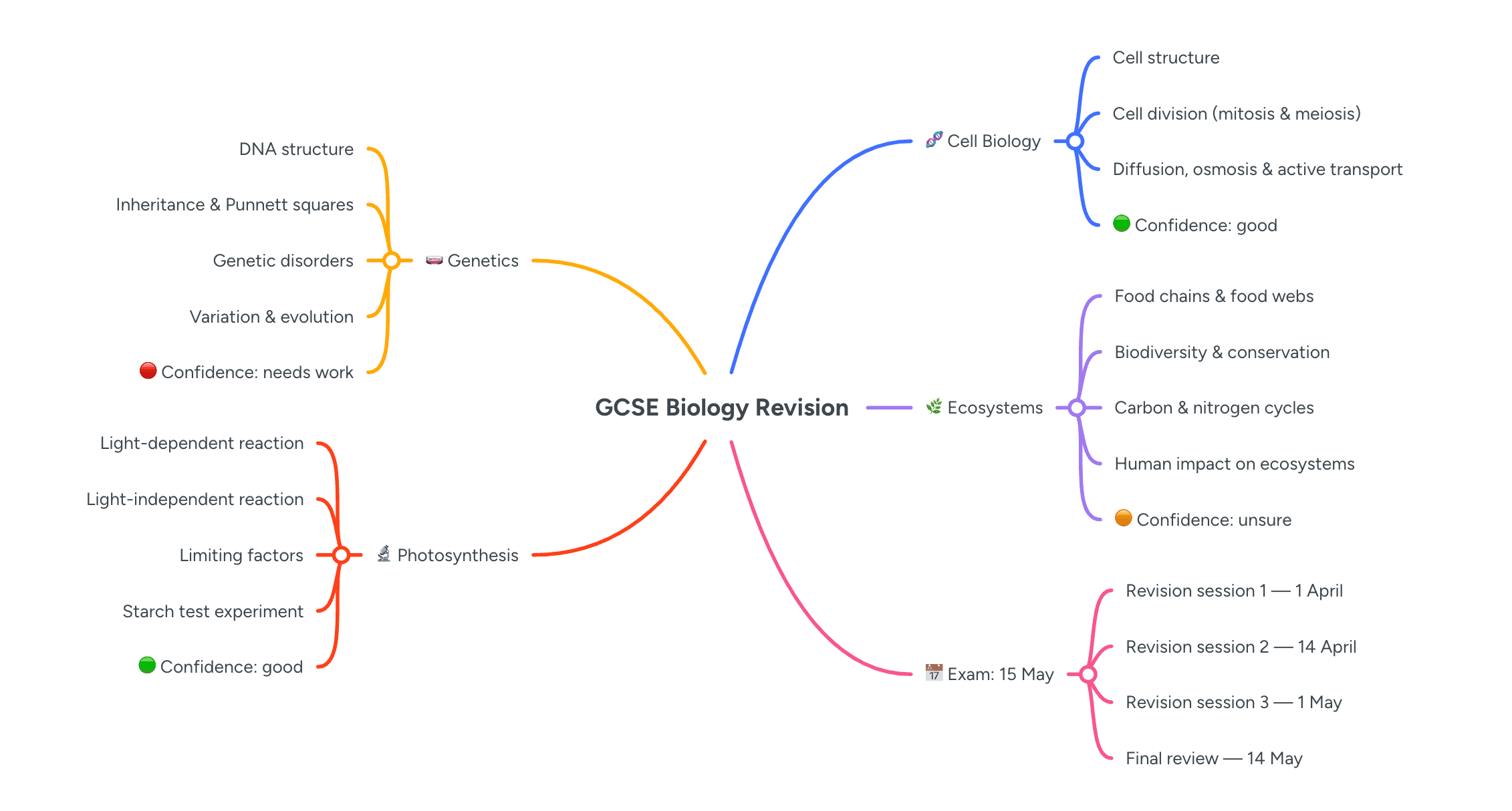 The colour-coding step is the most important one. It transforms the map from a summary of what you know into a visual guide for where to spend your time. Every revision session, update the colours based on how confident you feel after testing yourself. Over the weeks before your exams, red turns to amber, amber turns to green, and you can see your progress at a glance.
How to use a revision mind map for A Level
A Level revision is a different challenge. You have fewer subjects, typically three or four, but each one goes much deeper. The content is more complex, the essays are longer, the mark schemes are more demanding, and the exams are spread across a longer window from May through June.
The mind map structure works the same way but scales differently. At A Level, the branches under each topic are not just definitions and processes. They include arguments and counterarguments, case studies and examples, connections to other topics, and the kind of evaluative thinking that separates a C from an A.
Here is how to adapt the approach for A Level:
Build one map per subject with the main topics as branches. For example, "A Level History" with branches for each period or theme on your specification.
Under each topic, add sub-branches for the key arguments, evidence, and historians or theorists you need to reference in essays.
Add a separate branch labelled "Connections" under each topic for the links between topics that examiners reward. This is the synoptic thinking that A Level mark schemes look for.
For essay-based subjects, use the map to plan essay arguments before you write them. Central node as the question, branches as the key points, sub-branches as the evidence. The map becomes your essay plan.
For science subjects, use the map to track the relationships between concepts: equations, processes, and the conditions under which each applies.
The map below shows what a completed A Level History revision map looks like, with three topic branches each containing key arguments, historian references, essay questions and a dedicated Connections branch for the synoptic links that A Level mark schemes reward.
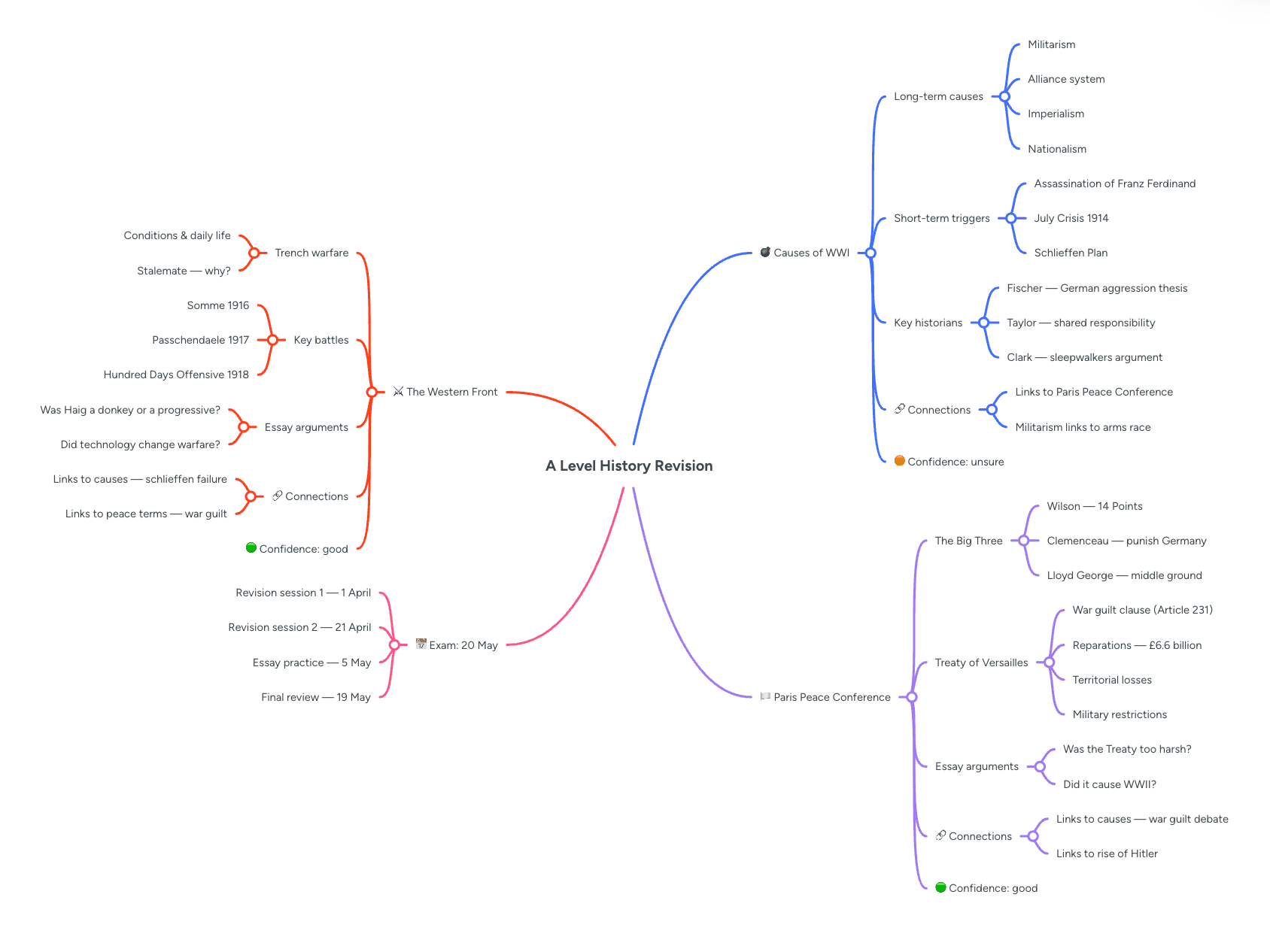 The connections branch is what separates A Level revision from GCSE revision. At A Level, knowing the content is not enough. You need to show how topics relate to each other and to the bigger questions of the subject. A mind map makes those connections visible in a way that a linear set of notes never can.
Mind map revision by subject: what to put on each branch
The structure of a revision mind map stays the same across every subject. What changes is what goes on the branches. Here is what to include for four of the most common GCSE and A Level subjects.
English Literature
Place the text title in the central node — for example, "Macbeth" or "An Inspector Calls." Add main branches for characters, themes, key quotations and context. Under each character branch, add sub-branches for their role, key moments and how they change across the text. Under each theme branch, add the quotations that support it and the characters most associated with it. For essay planning, add a branch for each likely exam question and map your argument across the sub-branches before you write a single sentence. The map turns a blank page into a structured argument route.
Mathematics
Place the topic in the central node — for example, "Algebra" or "Trigonometry." Add main branches for the key methods, formulae and types of problem that topic contains. Under each method branch, add sub-branches for the steps involved, the conditions under which that method applies and the common mistakes to avoid. For A Level Maths, add a Connections branch to show which topics feed into each other — for example, how differentiation connects to integration, or how logarithms connect to exponential growth. Maths mind maps work best as a reference tool built after you have practised problems, not before.
Geography
Place the unit or theme in the central node — for example, "Coasts" or "Development." Add main branches for the key processes, case studies and geographical concepts the unit covers. Under each case study branch, add sub-branches for the specific facts, statistics and place names you need to recall in the exam. For A Level Geography, add a Connections branch to show the links between physical and human geography themes — the synoptic element that A Level mark schemes specifically reward. Geography case studies are easy to confuse under exam pressure; having them on separate branches with specific data attached makes them much easier to retrieve accurately.
Biology
Place the topic in the central node — for example, "Cell Biology" or "Genetics." Add main branches for the key processes, definitions, and diagrams that the topic contains. Under each process branch, add sub-branches for the steps in order, the key vocabulary at each step and any required practical experiments linked to that topic. For GCSE Biology, colour-code by how well you know each process — red for processes you cannot explain without notes, green for processes you can explain clearly from memory. For A Level Biology, add a Connections branch to show how topics link across the specification — for example, how protein synthesis in Cell Biology connects to gene expression in Genetics.
Using active recall and spaced repetition with your revision map
Building a mind map is not revision in itself. It is the structure that makes revision more effective. The two techniques that cognitive science consistently identifies as the most effective for long-term retention are active recall and spaced repetition, and a mind map is the best visual tool for applying both.
Active recall with a mind map
Active recall means testing yourself on the material rather than re-reading it. With a mind map, this is straightforward. Build the map once from your notes. Then close it, open a blank map, and try to rebuild it entirely from memory. Every branch you cannot reconstruct is a gap. Open the original, check what you missed, then close it again and try once more. Repeat until you can rebuild the full map without looking.
This process is harder than re-reading. That difficulty is exactly what makes it work. The effort of retrieval is what moves information from short-term to long-term memory. A blank map forces you to retrieve. There is no way to fake it.
Spaced repetition with a mind map
Spaced repetition means coming back to the same topic at increasing intervals rather than covering it once and moving on. Memory decays quickly after a first encounter, but each time you successfully retrieve a topic, the decay slows and the memory becomes more durable.
In MindMeister, you can build spaced repetition directly into your revision map. Under each topic branch, add three or four dated revision nodes showing when you plan to return to that topic. Space them out: first review the day after your initial session, second review three days later, third review a week after that, fourth review two weeks before the exam. When you complete a review session, mark the node done and update the colour based on how confident you feel. For help structuring those sessions across all your subjects in the weeks before your exams, see our article on building a revision timetable.
For GCSE students revising a broad range of subjects, spaced repetition across the full map ensures no topic goes untouched for too long. For A Level students working with more advanced content, it ensures that complex arguments and case studies remain accessible in the weeks leading up to the exam.
Revision tips for the weeks before your exams
Six weeks out. Build your full subject maps from your notes. Colour-code by confidence. Identify the red topics and allocate extra time to those first.
Four weeks out. Begin active recall sessions. Close each map and rebuild from memory. Spend more time on the topics that are still red or amber. For A Level, start practising essay plans on the map before writing full essays.
Two weeks out. Your maps should be mostly green. Focus remaining sessions on the branches that have not shifted. Do one final complete active recall session per subject: rebuild the whole map from memory, then check.
One week out. Light revision only. Review the completed maps rather than rebuilding them. Focus on the connections between topics, particularly for A Level essay-based subjects. Avoid trying to learn new material at this stage.
The night before. Look at the map once. Do not try to memorise new branches. At this point, the map is a reassurance tool, not a revision tool. It shows you how much you know, not what you still need to learn.
Three revision mistakes that mind maps help you avoid
Building a revision map is not enough on its own. How you use it matters just as much as how you build it. These three mistakes are the most common reasons revision does not work, and a mind map addresses each one directly.
Mistake 1: re-reading instead of retrieving
Re-reading your notes feels productive because the material looks familiar. Familiarity is not the same as knowledge. When you re-read, your brain recognises the information rather than retrieving it, and recognition is far weaker than retrieval when it comes to what you can actually produce in an exam. The fix is to close your revision map and rebuild it from memory on a blank map. Every branch you cannot reconstruct is a gap. That gap is what you revise next, not the branches you already know.
Mistake 2: revising every subject for the same amount of time
Splitting revision time equally across all subjects feels fair but wastes it. If you already know Cell Biology well and still do not understand Organic Chemistry, spending the same time on both means you over-revise what you know and under-revise what you do not. The colour-coding system in your revision map solves this directly. Red branches get more time. Green branches get a quick review to maintain them. Your revision time goes where it is actually needed rather than where it feels comfortable.
Mistake 3: building the map but never testing yourself on it
A beautifully built revision map that you look at and never test yourself on is just a more visual version of re-reading. The map only becomes a revision tool when you close it and try to reconstruct it from memory. If you use your map as a reference document during revision rather than a retrieval challenge at the end of each session, you are not getting the benefit that makes mind mapping effective. The rule is simple: build the map from your notes, then test yourself on the map.
Start your GCSE or A Level revision map in MindMeister
Build your first revision map by placing your subject in the central node and adding the major topics as branches. Then, fill in the key concepts as sub-branches, and colour-code by confidence. That map is now your revision guide for that subject: a visual record of what you know, what you are unsure about, and where to focus next.
Start your GCSE or A Level revision map


