

Why small businesses need a competitive analysis
It's easy to mix it up with 2 related tasks. Market research studies your customers and their needs. A SWOT analysis looks inward at your own strengths, weaknesses, opportunities and threats.
A competitive analysis, by contrast, points outward at the businesses chasing your customers.
The Entrepreneur business encyclopedia suggests examining each competitor's market share, strengths and weaknesses, and the threats and opportunities they pose to you. Think of the result as a compass: it points you toward open ground.
Why bother if your business is small? Limited time and budget make every decision count, and a competitor analysis helps you make those decisions with more confidence:
Spot gaps in the market: unmet customer needs and underserved times, places or groups
Price with confidence: a clear picture of what similar offers cost nearby
Sharpen your message: unused promises and fresh angles for your own marketing
Avoid copying blind spots: a check against repeating weaknesses already common in your market
Decide faster with limited resources: a shared view of the facts instead of scattered notes and gut feelings
These benefits only appear when you compare the right businesses. That list is often longer than you expect.
Direct, indirect and substitute competitors
Any way a customer solves the problem today counts as competition. That includes businesses that look nothing like yours. The open textbook Entrepreneurship by OpenStax notes that a competitive analysis sometimes needs to focus on substitute products rather than direct competitors.
Direct competitors
Direct competitors sell the same product to the same audience in the same area. For a café, that's another café on the same street or a few blocks away. They fight for the same morning rush and the same regulars.
You probably know them by name already. Still, take a fresh look at them: check what they change, what they charge and what their customers praise.
Indirect competitors
Indirect competitors sell a different product that meets the same need. Think of a bakery with a coffee counter, the gas station on your commute or the office coffee machine. They all compete for the same morning cup.
Their main business may be bread, fuel or office space. Yet each cup they sell is a sale your café misses out on, so give indirect competitors a spot on your list.
Substitute competitors
Substitutes meet the underlying need or budget in a completely different way. For a café, that might mean making coffee at home, grabbing an energy drink or working from a co-working space with free coffee. Each option competes for the same few dollars and the same 15-minute break.
Founders often overlook substitutes because they don't look like businesses. A French press at home has no storefront, no menu and no social media account. Yet a customer who buys that press may skip your café for months, so give substitutes at least 1 spot on your shortlist.
How to do a competitive analysis in 6 steps
You don't need a research team to run a competitor analysis. You need a short list, clear criteria and a few focused hours. These 6 steps keep the work manageable and turn scattered facts into decisions.
1. Identify your competitors
Start with a shortlist of 3 to 5 competitors and cap it at about 10. Aim for a mix: mostly direct competitors, 1 or 2 indirect ones and 1 substitute.
To build the list, think like a customer:
Ask customers which other options they considered before choosing you
Search for your product and area the way a new customer would
Check review platforms and local listings for businesses near you
Note which names come up again and again
Stop when new searches only bring up names you already have.
2. Set your criteria
Criteria keep your comparison fair. Use the same set for every competitor so you can compare like with like and spot differences quickly. These 6 cover the basics:
Offer: main products, services and signature items
Pricing: price points, bundles, discounts and loyalty perks
Target audience: core customer groups, such as students, commuters or families
Strengths: clear advantages, such as speed, quality or location
Weaknesses: recurring complaints, gaps and inconsistent experiences
Marketing channels: social media, newsletters, local press, events and signage
Then add 1 or 2 criteria specific to your business. For a café, location and opening hours matter. For an online shop, shipping times and return rules might matter more.
3. Gather information
You can find most of what you need for free. Start with these no-budget sources:
Websites, menus and price lists
Online reviews
Social media channels and newsletters
Your own visits as a customer ("mystery shopping")
Job ads, which hint at growth plans
Local press coverage
Your team and your customers
Set a time limit, for example, 2 hours per competitor, so research doesn't swallow your week.
As you go, separate facts from opinions. A latte price of $5.50 is a fact. "The staff seemed rushed" is an impression, so label it that way.
4. Compare competitors in a mind map
Why use a mind map instead of a long spreadsheet? A mind map shows every competitor and criterion on 1 canvas, so you spot patterns at a glance. A mind map tool like MindMeister makes this setup quick.
Create a central topic called "Competitive analysis." Add 1 branch per competitor and give each the same 6 sub-branches for your criteria. Then use the mind map's visual tools:
Green for strengths and red for weaknesses, plus icons for quick scanning
Screenshots and links attached to the topics they support
Real-time collaboration, so teammates fill different branches in parallel
Collapsed branches to compare 1 criterion across all competitors
Collapse everything except "Pricing," for example, and you see every price point side by side.
5. Derive opportunities
Now the mind map pays off. Add a new main branch called "Opportunities" and look across all competitors for patterns:
Unmet needs: customer requests in reviews with no matching offer nearby
Shared weak spots: problems common to every competitor on your mind map
Crowded positions: promises and price points already taken by several rivals
Phrase each opportunity as a concrete move. "Offer a $7 breakfast bundle before 9 a.m." works better than "Improve breakfast." Pick your top 3 and park the rest in a separate branch for later.
6. Review regularly
Markets move, so your mind map should too. Review your competitive analysis once a quarter and whenever something big shifts:
A new competitor opens nearby
A rival changes prices
A competitor launches a new product
Keep working in the same mind map and add a date stamp to each update, so you see how the competitive landscape shifts over time. Feed the findings into your strategic planning so each review shapes your goals for the next quarter.
Example: a small café chain compares 3 competitors
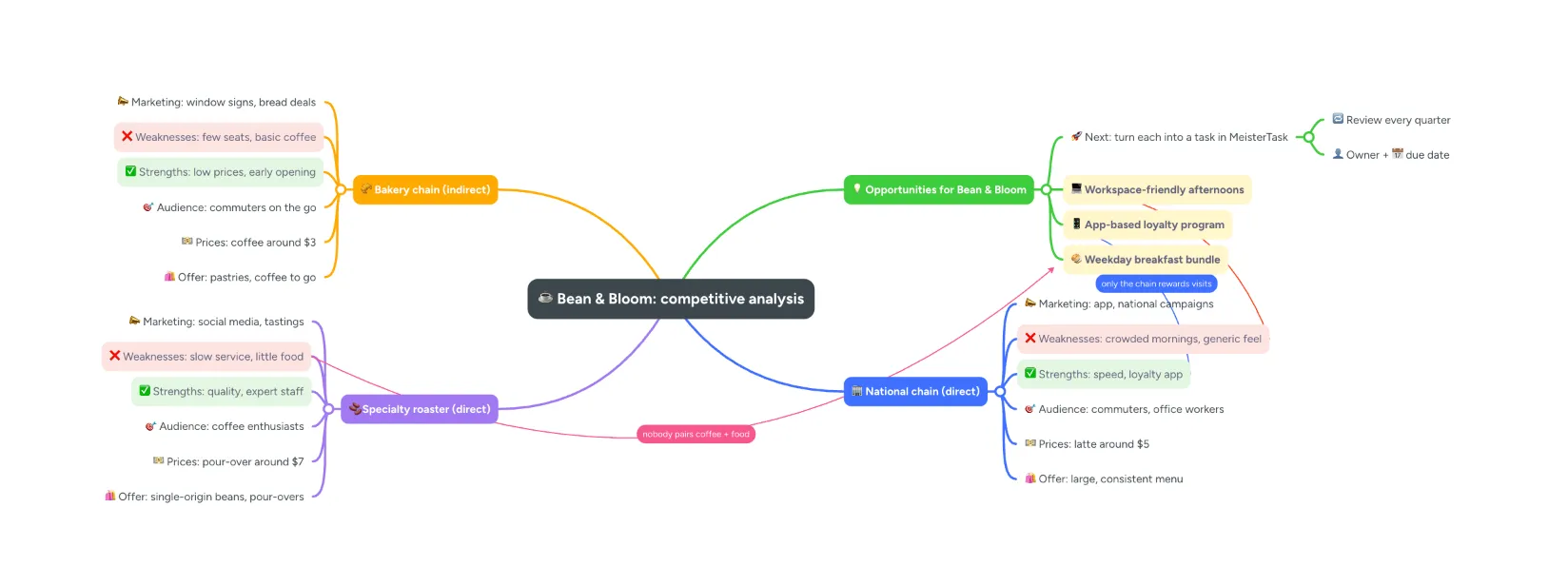
Bean & Bloom is a fictional café chain with 3 locations in the same city. The owners want to grow weekday sales without a big marketing budget. They map 3 competitors in MindMeister: 2 direct and 1 indirect.
Each competitor gets the same 6 sub-branches, and each finding is colored green or red. Here is what the owners find.
The national chain branch (direct). It sits 2 blocks from Bean & Bloom's busiest location and offers a large, consistent menu with lattes around $5. Speed and an app-based loyalty program are clear strengths, while crowded mornings and a generic feel are weaknesses. Its marketing runs through the app and national campaigns.
The independent specialty roaster (direct). It targets coffee enthusiasts with single-origin beans and pour-overs around $7. Reviews praise the quality and staff knowledge but note slow service and limited food options. The roaster promotes itself on social media and through in-store tastings, with no loyalty program at all.
The bakery chain with coffee-to-go (indirect). Commuters stop here for pastries and grab a $3 coffee on the side. Low prices and early opening hours are strengths, while limited seating and basic coffee are weaknesses. Its marketing relies on window signs and weekly bread deals.
Patterns show up quickly once the branches sit side by side. Nobody nearby combines good coffee, food and space to work, and only the chain rewards repeat visits. So Bean & Bloom adds its Opportunities branch:
Weekday breakfast bundle: coffee and a pastry for commuters, at a price between the bakery and the chain
App-based loyalty program: a perk missing among the independent cafés in town
Workspace-friendly afternoons: reliable Wi-Fi and power outlets during the quiet hours after lunch
The team now has 3 concrete moves to test over the next quarter, each backed by a pattern in the research. Each move gets an owner and a review date right on the mind map.
Competitive analysis template: criteria × competitors
Use this template to collect your findings before you map them. Copy it into a document or spreadsheet and fill 1 column per business, starting with your own.
Criteria
You
Competitor 1
Competitor 2
Competitor 3
Offer (main products and services)
Pricing (price points, bundles, perks)
Target audience (core customer groups)
Strengths
Weaknesses
Marketing channels
Opportunities for you
A few habits keep the grid useful:
Keep cells short: a few words or a number per cell
Stick to 1 fact per cell: clean comparisons across every column
Mark source and date: a short note such as "menu, March 12" next to each fact
Rebuild it as a mind map: each column as a branch and each row as a sub-branch
The table works well for a first pass. As your research grows, a mind map gives you room for screenshots, comments and a dedicated Opportunities branch.
From analysis to action with MeisterTask
MindMeister helps you collect and structure your competitor research, and MeisterTask helps you act on it. They are 2 separate products, and MindMeister integrates with MeisterTask, so you can create a task in MeisterTask from any topic on your mind map.
Start with the 3 opportunities you prioritized. Create a task for each, then open MeisterTask to assign an owner and a due date. Track progress on a project board with sections such as "To do," "Doing" and "Done." Bean & Bloom, for example, would create 3 tasks for the breakfast bundle, the loyalty program and the workspace-friendly afternoons.
Each task needs 3 things to move forward:
Owner: 1 person responsible for moving the task forward and reporting back
Deadline: a realistic due date, ideally before your next quarterly review
Success signal: a simple, observable sign of progress, such as more weekday breakfast orders
Link these tasks to your marketing plan so campaigns and competitor insights stay connected. Check the board in a short weekly meeting. A quick look at what moved and what's stuck keeps every task alive. Your analysis then turns into work your team can see, discuss and finish.
Common mistakes in competitive analysis
Even careful teams fall into a few traps. Most of them come down to scope, focus or follow-up, and each is easy to fix once you spot it.
Only looking at direct competitors: a narrow view that misses the bakery, the gas station and the coffee maker at home
Too many criteria: a crowded grid with no clear pattern and no time left for decisions
Copying instead of differentiating: matching a rival's offer step for step and giving customers no reason to switch
Mixing opinions with facts: treating a single bad visit or a hunch as hard data
Running it once and filing it away: a snapshot gone stale within months
No owner for follow-up: good ideas sitting in the mind map with nobody to act on them
Most of these mistakes disappear when your analysis has a clear structure, a review date and an owner. To measure the distance between where your business is and where you want it to be, pair your findings with a gap analysis.
Turn competitor research into your next move
A competitive analysis works well as a habit. Pick 3 to 5 competitors, compare them on the same criteria and turn the patterns into a short list of moves. Review the mind map every quarter to keep pace with your market.
MindMeister gives your team a shared canvas to collect research, mark strengths and weaknesses in color and spot opportunities together in real-time collaboration. When you're ready to act, connect your mind map with MeisterTask and turn each opportunity into a task with an owner.
Map your competitors & spot opportunities