
What is a gap analysis?
A gap analysis is a structured way to compare where you are now with where you want to be, then name the difference so you can act on it. Think of it as a bridge: your current state sits on one bank, your future state on the other, and the gap is the span you have to build. Management resources like Mindtools' gap analysis method describe it as a technique for comparing your current situation with the future state you want and identifying the tasks to bridge the gap.
Every gap analysis has the same 3 components. The current state is an honest picture of how things work today. The future state is the specific result you're aiming for. The gap is the measurable difference between the two, plus what it will take to close it.
Teams reach for a gap analysis at predictable moments. You might run one during a planning cycle, after an organizational change, before a capability review, or when preparing for a compliance or audit deadline. In each case, the value is the same. You replace guesswork with a clear view of what's missing and why.
The word "template" matters here. A gap analysis template gives you a repeatable shape to fill in, so you spend your energy on the thinking rather than on the format. The same 3 components appear every time, whether you're reviewing skills, systems, or performance, which is what makes the method easy to learn once and reuse for years.
When to run a gap analysis (and when not to)
A gap analysis earns its keep when you have a real target and a real starting point that don't yet match. Common triggers include a new goal for the quarter, a move into a new market, an audit finding you have to resolve, a restructure that shuffles who does what, or a capability review that asks whether your team can deliver the next plan. For a restructure, it helps to pair the analysis with a stakeholder mapping method to identify who each change affects.
If your future state is still fuzzy, a gap analysis will just produce a list of vague wishes. Run a strategy session first and agree on the target, then come back and measure the gap.
The same goes for a single either-or decision. If you're choosing between 2 vendors or 2 routes, a gap analysis is overkill. A simple decision matrix does the job faster. And if you need a broad scan of your whole position rather than a fixed target, learning how to run a SWOT analysis is a better starting point. Save the gap analysis for the situations where you know the destination and need a clear read on how far away you are. A visual mind map helps here, too, because an unclear future state shows up fast when you try to draw the target branch and can't fill it in.
How to do a gap analysis in five steps
The method is short. What makes it work is discipline at each step. These 5 steps translate cleanly onto a MindMeister mind map, with each step becoming a branch you can expand as your thinking grows.
Step 1: Define the future state clearly
Start with the target because everything else is measured against it. A good future state has 3 parts: a value, a date, and the underlying assumption. "Grow faster" is not a target. "Reach 400 qualified leads a month by the end of Q3, assuming we keep our current ad budget." Write the target on its own branch so the whole team can see and challenge it. For a repeatable way to write and track targets, our approach to goal setting with a mind map pairs well with this step.
Step 2: Audit the current state honestly
Now capture where you actually stand. Record each baseline with its source, the date you measured it, and a clear definition, so no one argues later about what the number means. Use the same measure on both sides of the comparison. If your future state counts qualified leads, your current state has to count them the same way. Separate facts from estimates and assumptions, and label each one. A number you pulled from a report is a fact. A figure someone guessed at in a meeting is an estimate and should carry less weight.
Step 3: Name the gap in specific terms
With both states in front of you, the gap is simply the difference between them. Write it down in concrete terms, not as a feeling. "We're 150 leads a month short of target." beats "our pipeline is weak." It also helps to classify each gap, because the type points you toward the fix. A performance gap is a metric below its target. A capability gap is a skill or resource you don't yet have. A process gap is a broken or missing workflow. A compliance gap is a control that falls short of a required standard.
Step 4: Identify the root causes of each gap
A gap is a symptom, so resist the urge to jump straight to solutions. For each gap, run the 5 Whys: ask "why" until you reach a cause you can actually change. You can start from a ready 5 Whys root cause template to keep the questioning structured. If leads are short, why? The blog publishes less often. Why? No one owns the calendar. That root cause, an unowned calendar, is something you can fix. Adding more ad spend would have treated the symptom and left the real problem in place.
Step 5: Turn each gap into an owned action with a due date
Every gap needs one owner who controls the inputs, one clear next action, and one check-in date. Not a committee, not "the team," one person who can actually move the metric. When an action sits on a mind map branch with a name and a date attached, it stops being a good intention and starts being a commitment you can track.
Gap analysis example: a marketing team rebuild
Here's how it looks end-to-end. Picture a MindMeister mind map with the root topic "Marketing team 2026" and 2 main branches: current state and future state.
On the future state branch, the target reads: 400 qualified leads a month by the end of Q3, assuming the current budget holds. On the current state branch, the honest baseline is 250 qualified leads a month, measured from last quarter's pipeline report, with the blog publishing twice a month and no content owner named.
Between the branches sit the gap sub-branches. The first gap is a performance gap: 150 leads a month short. Run the 5 Whys, and the root cause surfaces: publishing is inconsistent because no one owns the editorial calendar. A second gap is a capability gap: no one on the team can run paid search well.
Each gap becomes an owned action with a due date. "Assign an editorial calendar owner and publish weekly, owner Priya, due March 15." "Hire or train a paid-search lead, owner Sam, due April 30." Because every action carries its own name and date on its branch, the whole plan stays visible on one page, and anyone can see at a glance which gaps are moving and which are stuck.
Types of gap analysis
The same method flexes to fit different problems. Here are 4 common types and when each one fits.
Skills gap analysis (HR / L&D)
A skills gap analysis compares the capabilities your team has today against the skills your strategy will need. HR and learning teams use it to plan hiring and training. The World Economic Forum's Future of Jobs Report 2025 found that skill gaps are the single biggest barrier to business transformation, with about 39% of existing skill sets expected to change by 2030, so this type is worth revisiting often. For example, if next year's plan leans on data analysis but only 1 person can build a dashboard, that's a skills gap you can close with training or a new hire.
Fit gap analysis (system implementation)
A fit gap analysis compares a new system's capabilities against your actual requirements before you commit. It's common during software rollouts. You list each requirement, then trace it to a demo, a test, or a contract clause that proves the system meets it. Anything you can't trace is a fit gap to resolve with a workaround or a different tool.
Performance gap analysis (KPI vs target)
A performance gap analysis compares an actual result against the target you set for it. It's the fastest type to run because the numbers usually exist already. If your support team answers tickets in 8 hours but the target is 4, that 4-hour gap is the issue, and the analysis points out why it's happening.
Compliance gap analysis (audit vs required standard)
A compliance gap analysis compares your current controls against the standard you must meet. Security and quality teams run these before an audit. You compare each requirement in the standard to what you actually do today, and every requirement you don't yet meet becomes a gap with an owner and a deadline attached.
Free gap analysis template in MindMeister
MindMeister gives you a ready structure, so you don't start from a blank page. The template opens as a mind map with the analysis at the center and 2 main branches, current state and future state. Under those, you add gap sub-branches, and each gap includes its root cause, an action with an owner, and a due date. Everything lives on one page, so you never lose a gap in a long document.
To use it, duplicate the template into your own account and rename the root topic to match your project. Fill in the future state first, then the current state, then let the gaps and actions grow branch by branch. Add notes to any topic to record a source or an assumption, and share the mind map, so your team can add and challenge ideas in real-time collaboration. When you present, use presentation mode to walk stakeholders through each gap in order.
Ready to find your own gaps? Sign up for free and open the gap analysis template in MindMeister.
Handing gaps off to real work
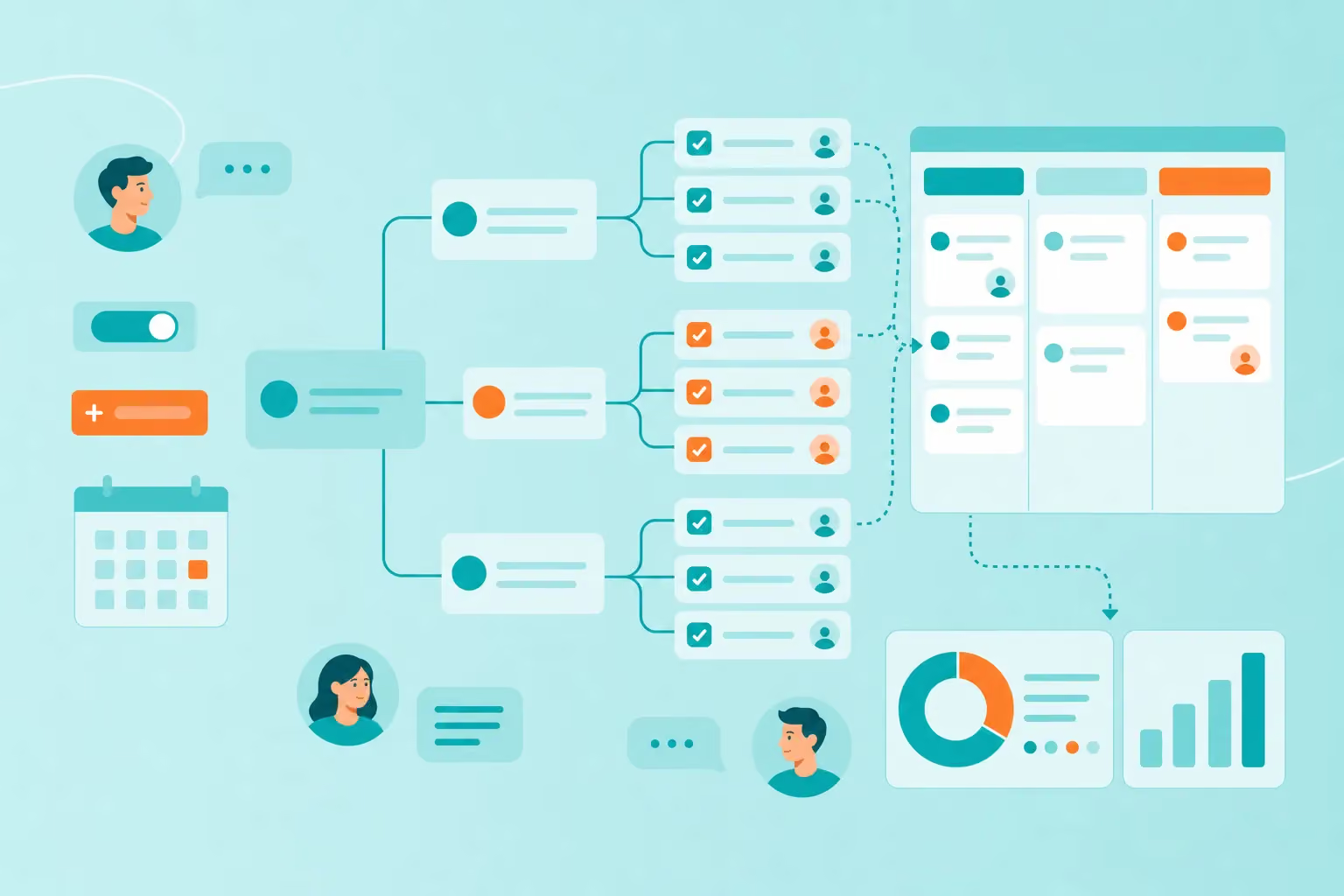
A gap analysis is only useful if the gaps are actually closed, which means the plan has to leave the drawing board. MindMeister is where you think and see the whole picture. MeisterTask is where the work gets done. Turn each action on your mind map into a task in MeisterTask, complete with an owner and a due date, and track it to done alongside the rest of your team's work. The analysis stays visible as a mind map, while the actions move through a clear workflow, so nothing slips between planning and execution.
Common mistakes when running a gap analysis
A few habits quietly sink a gap analysis. Watch for these:
Vague future state: a target like "be better" gives you nothing to measure against
No owner on each gap: actions without a name attached rarely get done
Skipping root cause: jumping to solutions treats symptoms and leaves the real problem in place
Running it once: a gap analysis is a snapshot, so revisit it as the plan and the baseline change
Map your gaps and turn them into real action.