
What a PESTEL analysis is
A PESTEL analysis is a structured scan of the outside forces that affect your business. These are macro-environmental factors: trends and shifts you can't control but still need to plan for. Think of it as checking the weather before a road trip: You can't stop the storm, but you can pack a raincoat or pick a different route.
The framework has a long track record. Its roots trace back to Harvard professor Francis Aguilar in the late 1960s. Since then, the model picked up new letters and new names along the way.
Each letter stands for 1 factor. Together, they give you a clear picture of your market before you commit time and money. The results help you answer a practical question: "What's happening outside our business that could help or hurt our plans?"
PEST vs. PESTEL vs. PESTLE
The names vary, which can cause confusion. The core idea stays the same. Here's how the main versions compare:
PEST: the original 4 factors of political, economic, social and technological
PESTEL: PEST plus environmental and legal factors, for 6 in total
PESTLE: the same 6 factors as PESTEL, with legal and environmental swapped
STEEPLE: a wider variant that adds ethical factors to the 6
PESTEL and PESTLE mean the same thing. Pick the name your team already knows and stick with it.
Why a PESTEL analysis matters for small businesses
When you run a small business, you rarely have time to watch every trend. A PESTLE analysis gives you a quick, repeatable way to look up from daily work and check what's coming. Say you run a 12-person coffee roaster. A jump in import tariffs or a new packaging rule could squeeze your margins within months, so you want to know early.
The framework pays off in 4 ways:
Spot risks early: You catch changes in rules, costs or customer habits before they hurt your margins
Find new opportunities: You notice gaps that bigger rivals may miss, such as a new customer group or a funding program
Make better-informed decisions: You base market entry, product launches and annual strategy on checked facts instead of gut feel
Build a shared view: Your team wears many hats, and everyone works from the same picture of the market
You don't need a strategy department to get these benefits. You need a clear structure and a few focused hours with your small business team.
The 6 PESTEL factors explained
Each factor examines a different aspect of your business environment. Use the questions below as a starting point and adapt them to your industry. You don't need an answer to every question; focus on the ones that matter to your decision.
Political factors
Political factors cover government actions and policy choices that shape how you do business. They include trade policy, tax policy and public support for companies.
Could new tariffs or trade rules change your costs?
Are there government funding programs you could apply for?
How stable is the political climate in your target market?
Economic factors
Economic factors describe the wider economy and how it affects your costs and sales. Interest rates, inflation and exchange rates are the usual suspects.
How would higher interest rates affect your loans or growth plans?
Is inflation pushing up your supplier prices?
Do exchange rates change what you pay or earn abroad?
Social factors
Social factors look at your customers as a group: their age, values, lifestyles and buying habits. Shifts here often change what customers want from you.
Is your target customer group growing or shrinking?
How are buying habits changing, online or in-store?
Which values, such as health or sustainability, influence purchases?
Technological factors
Technological factors cover new tools and channels that change how you make, sell or deliver products. Automation, AI and digital sales channels all belong here.
Could automation lower your production or admin costs?
How might AI change your service or your competitors' offers?
Which digital sales channels do your customers use most?
Environmental factors
Environmental factors cover climate, natural resources and rising expectations around sustainability. For many small businesses, packaging and waste rules also apply here.
How exposed is your supply chain to extreme weather?
Do your customers expect greener products or packaging?
Are packaging or recycling rules changing in your market?
Legal factors
Legal factors are the laws and regulations you must follow. They overlap with political factors but focus on rules already in force or about to take effect.
Do changes in employment law or minimum wage affect your staff costs?
How do data protection rules affect the way you store customer data?
Which product safety or labeling standards apply to your products?
How to run a PESTEL analysis in 5 steps
Where do you start when the whole world counts as "external"? Treat your PESTLE analysis as a short, focused project instead of an endless research task. These 5 steps keep it practical.
1. Define your scope
Name the decision first: entering a new market, launching a product or setting next year's strategy. A clear decision tells you which factors deserve the most attention.
Next, define the market and the time horizon. A regional bakery planning for the next 2 to 3 years needs different inputs than a software company looking 10 years ahead. Write your scope at the center of your mind map so everyone sees it.
2. Collect factors per branch
Create 1 branch for each of the 6 factors. Then brainstorm with your team, branch by branch, and add every relevant trend or change you can think of. Don't filter yet: volume matters more than polish at this stage.
After the brainstorm, check your ideas against reliable sources such as national statistics offices and industry associations. Invite colleagues from sales, finance and operations too. CIPD advises a collaborative approach, because multiple perspectives can identify more risk.
3. Rate the impact
Not every finding deserves the same attention. Rate each one on 2 scales: how big the impact would be and how likely it is to happen. Then combine both into a simple rating:
High: strong impact and likely to happen soon
Medium: noticeable impact or moderate likelihood
Low: minor impact or unlikely to happen
Use colors to make the ratings visible, for example, red for high, yellow for medium and green for low. A quick look at the mind map then shows you where to focus.
4. Derive opportunities and risks
Now sort each high or medium finding into 1 of 2 groups: opportunity or threat. Rising interest in eco-friendly products is an opportunity for a green brand. A new labeling rule could pose a threat if it increases your costs.
Some findings fit both groups. A new digital sales channel can open a market but also bring new competitors. Note both sides and pick 2 to 3 priorities for each group. A gap analysis then shows how far you are from where these priorities need you to be.
5. Review regularly
External factors keep moving, so your analysis has a shelf life. Review it as part of your annual strategy planning. Also revisit it before you enter a new market or launch a product.
Big external shifts are another trigger.
Keep the mind map in a shared place, so updates take minutes.
PESTEL analysis example: a small business entering a new market
A worked example makes the framework easier to apply. Picture a 20-person US company that makes plant-based cleaning products. The team plans to start selling in Canada and wants to understand the outside forces first.
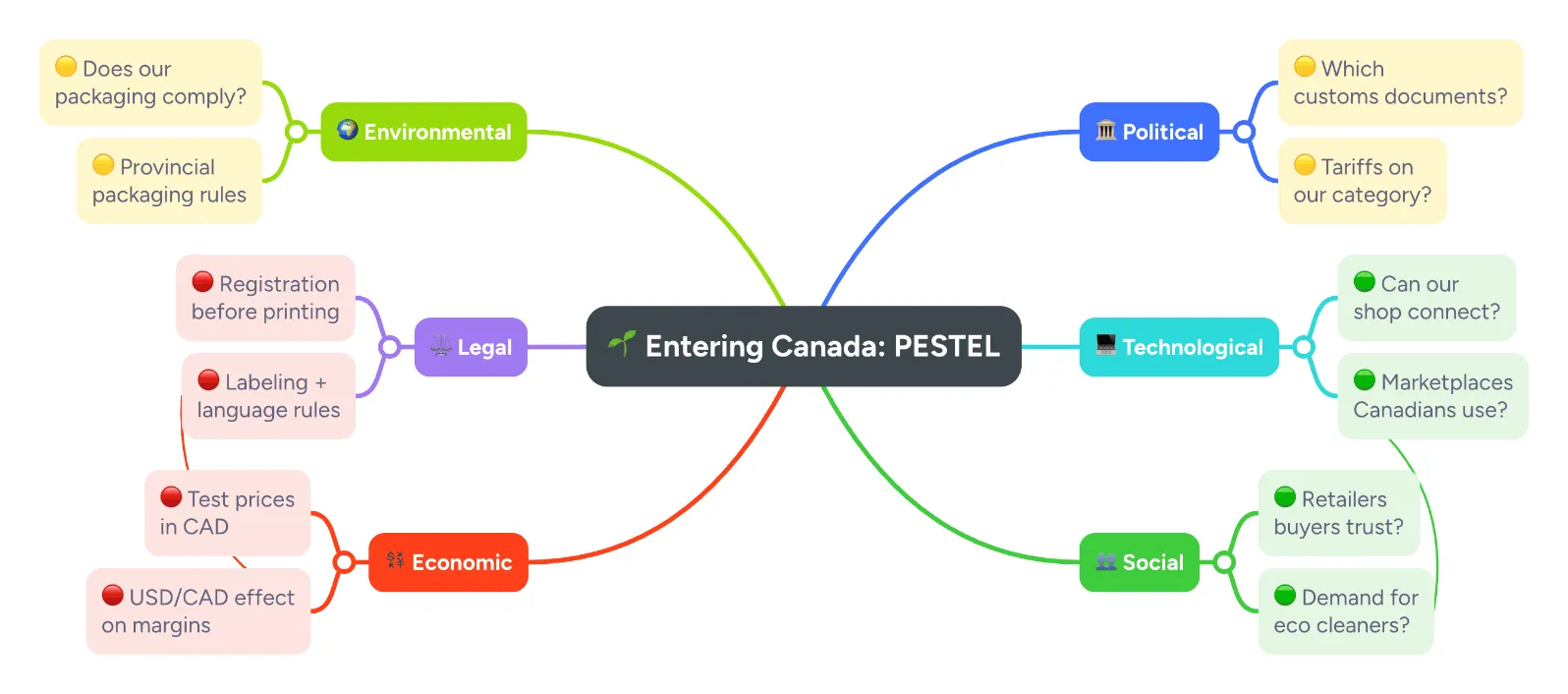
The central topic of their mind map reads "Entering Canada." Each of the 6 branches holds 2 findings written as questions to check, not as settled facts:
Political: Check whether tariffs apply to your product category and which customs documents your shipments need
Economic: Model how the USD/CAD exchange rate affects your margins and test your price points in Canadian dollars
Social: Verify how strong demand for eco-friendly cleaning products is and which retailers your target customers trust
Technological: Research which online marketplaces Canadian shoppers use and whether your e-commerce setup can support them
Environmental: Look into provincial packaging and recycling rules and check whether your current packaging meets them
Legal: Confirm product labeling and language requirements and any registration rules before you print packaging
Next, the team color-codes each finding by impact. Legal and economic findings get red, since a labeling mistake or a weak exchange rate could stall the launch. Social and technological findings turn green because they indicate growth.
After the review, the team flags 2 likely opportunities to confirm: demand for eco-friendly products and the presence of established online marketplaces. It also flags 2 top risks: labeling requirements and exchange-rate pressure on margins. Each item now needs research and an owner before the launch plan and business plan move forward.
PESTEL analysis template with guiding questions
Use this structure to start your own mind map. Put your decision at the center, add 1 branch per factor and use the questions below as sub-topics. Replace each question with your findings as you go.
Political: Which trade rules could affect you? Which public funding could you use?
Economic: How do interest rates and inflation affect your costs? How do exchange rates change your prices?
Social: Which customer groups are growing? Which values shape their buying decisions?
Technological: Which tools could cut your costs? Which sales channels do your customers prefer?
Environmental: Which climate risks affect your supply chain? What do customers expect on sustainability?
Legal: Which employment, data or product safety laws apply? Which rule changes are coming?
Then add 2 extra branches to turn your findings into decisions. Together with the central topic, they frame the whole mind map:
Central topic: your decision, market and time horizon, such as "Launch in Canada within 2 years"
Impact rating: a high, medium or low rating for each finding, marked by color
Next steps: the actions, owners and deadlines that follow from your top findings
Keep each sub-topic short. A few words per finding make the mind map easier to scan and discuss.
PESTEL vs. SWOT: how they work together
PESTEL and SWOT often appear together, but they address different questions. A PESTEL analysis examines only the external environment. A SWOT analysis looks at your internal strengths and weaknesses plus external opportunities and threats.
The 2 methods fit together in a simple sequence:
PESTEL first: You collect and rate the external forces in your market
SWOT second: You add your internal strengths and weaknesses to the picture
Shared quadrants: Your PESTEL findings feed straight into the opportunities and threats of your SWOT
When you run a SWOT analysis, use your top PESTEL findings as the starting point for the external quadrants. The result is a strategy grounded in both your market and your own capabilities.
Turn your PESTEL mind map into action with MindMeister and MeisterTask
An analysis only pays off when findings lead to action. Online tools like MindMeister give your PESTEL analysis a visual home, with 1 branch per factor and colors for impact. Your team works on the same mind map through real-time collaboration and adds comments wherever a finding needs discussion.
1 branch per factor: You see all 6 factors and their findings on a single canvas
Color-coded impact: You mark high, medium and low ratings so priorities stand out
Comments on topics: Your colleagues add context, sources or doubts right where a finding sits
Secure sharing: You invite teammates or advisers and control who can view or edit the mind map
When it's time to act, MeisterTask takes over. MeisterTask is a separate task management app that integrates with your mind maps. Create a task from a topic, assign an owner and set a due date.
In the Canada example, the "Confirm labeling requirements" topic becomes a task for the operations lead. The due date lands well before packaging goes to print.
From outside forces to a clear plan
A PESTEL analysis helps you identify external forces affecting your business before they catch you by surprise. Define your scope, collect findings per factor, rate their impact and sort them into opportunities and risks. Review the mind map regularly and it stays useful long after your kickoff session.
Mind mapping makes this work visual and easy to share with your team. With MindMeister, you build your analysis branch by branch, discuss findings with colleagues and update it as your market changes. Start with your next big decision and see which outside forces shape it.
Map your PESTEL analysis with MindMeister