


What a business plan needs to include
Most business plans share the same core sections, whether you want a bank loan, investor funding or a clear direction for a new venture. The U.S. Small Business Administration's business plan advice lists an executive summary, a company description, a market analysis and sections covering marketing, management and financial projections. You can group these parts of a business plan into 7 sections:
Executive summary: a short overview of the whole plan, written last but placed first
Company description: your mission, the problem you solve and the customers you solve it for
Market analysis: market size, target segment and the competitors you face
Products or services: what you sell, how you price it and which customers' needs it meets
Marketing and sales strategy: how you reach customers, position your offer and close sales
Operations: your team, location, suppliers and day-to-day processes
Financial projections: expected revenue, cost categories, break-even timeline and funding needs
The order matters, with an exception at the top. The executive summary opens the finished document, but you write it at the end, because it's far easier to summarize the plan once every other section exists.
These business plan components also depend on each other. Your market analysis shapes your marketing strategy, your operations determine your cost structure and your financial projections depend on both. Writing them in a linear document is like learning a city by walking a single street: You see every detail of that block but miss how the neighborhoods connect.
A mind map shows you the whole city first. It gives you the same big-picture view you'd use for strategic planning, so you spot the links between sections before you write a word.
How to outline a business plan as a mind map in MindMeister
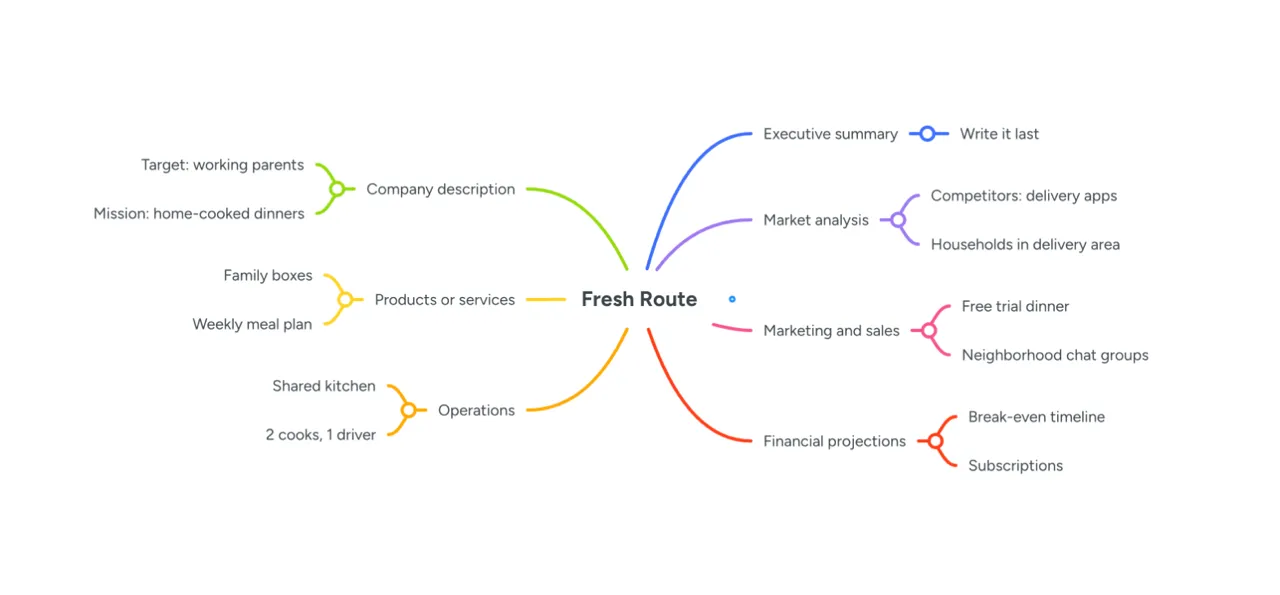
The 7 steps below build a complete business plan outline. The running example is Fresh Route, a small neighborhood meal delivery business that cooks dinners in a shared kitchen and delivers them to nearby households. Follow along with your own business in mind.
Step 1: Put your business name in the central topic
Open a new mind map in MindMeister and type your business name in the central topic. For example, that's "Fresh Route." Add a short note under the name that states the plan's purpose, such as "Bank loan application" or "Pitch for local investors."
The purpose decides how much detail each branch needs later. A lender wants to see how you'll repay a loan, while an investor wants to see how far the business can grow. Settle this before you add anything else.
Step 2: Add 7 main branches
Create a main branch for each section of the written plan, centered on the central topic. Place the branches clockwise in the order they appear in the document. Start with "Executive summary" at the top, then continue with company description, market analysis and the rest.
Leave the executive summary branch empty for now. You'll fill it in once every other branch is complete. Because the mind map already follows the document's order, turning it into a draft later takes less rework.
Step 3: Map your company description
Give the company description, branch 3, sub-branches: mission, problem solved, and target customer. Fresh Route's mission is "Home-cooked dinners for busy neighbors." The problem is that working households lack the time to cook healthy meals on weeknights.
The target customers are working parents and older residents within the delivery area. If the mission and problem branches feel vague, define your value proposition before proceeding. Every later branch builds on it.
Step 4: Break down your market analysis
Add sub-branches for market size, target segment and competitors. Under market size, note how many households sit inside your delivery area and where you found that data. Under competitors, list 2 or 3 rivals, each with a strength and a weakness:
Delivery apps: wide restaurant choice, but service fees push up the price of each order
Local takeout: loyal regulars, but few healthy options on the menu
Supermarket ready meals: low prices, but heavily processed food
If you don't have this information yet, run a SWOT analysis before planning. That way, each entry rests on evidence rather than a hunch.
Step 5: List your products or services
Add a sub-branch for each offering, then attach 2 details to it: the price point and the customer need it meets. Keep price points relative for now. Fresh Route has 3 offerings:
Weekly meal plan: mid-range price point for households that want every weeknight dinner sorted
Single dinners: premium price point for occasional orders on busy evenings
Family boxes: value price point for larger households that feed 4 or more
Step 6: Plan marketing and sales
Split this branch into acquisition channels, pricing strategy and sales process. Fresh Route's channels include flyers, neighborhood messaging groups and partnerships with local gyms. Its pricing strategy rewards subscriptions over single orders, and its sales process guides a customer from a free-trial dinner to a weekly plan.
Now draw a connection line from the delivery apps' weakness in Step 4 to a new positioning sub-branch: "Fresh local dinners without the service fees."

Step 7: Sketch your financial projections
Add sub-branches for revenue streams, cost categories, break-even timeline and funding requirements. Keep them as labels, such as "Subscriptions," "Ingredients" or "Kitchen rent," and leave the numbers for your spreadsheet. Draw a connection line from the market size in Step 4 to the revenue projections, since your reachable households cap what you can sell.
Before you finish, give the operations branch 4 sub-branches so no section stays empty:
Team: 2 cooks, a driver and the founder handling orders
Location: a rented space in a shared commercial kitchen
Suppliers: local farms and a wholesale produce market
Processes: order cut-off times, packing and delivery routes
Operations involve people outside your business, such as the kitchen landlord and your suppliers, so map your stakeholders early. Each of these sub-branches later becomes a paragraph in your operations section.
Your finished mind map structures your thinking, but it has clear limits. It doesn't replace the financial model, the market research or the written document.
You still need a spreadsheet to calculate costs and revenue. You need real customer data to test your assumptions. And lenders or investors still expect a full written plan that they can read.
3 business plan mind map examples
The same 7-branch structure adapts to very different businesses.

Here's how the sub-branches shift across 3 common types of small business plans.
Small business example: a neighborhood bakery
A bakery depends on local demand, so its market analysis branch zooms in on foot traffic, nearby offices and competing bakeries. The products branch lists the menu items with a price tier for each. Marketing is split into walk-in sales and delivery orders, and startup costs are listed under financial projections as categories.
Local market analysis by street and time of day
Product menu with a price tier for each item
Walk-in and delivery marketing channels
Startup cost categories for ovens, fit-out and permits
Freelance example: a solo marketing consultancy
A solo consultant has no premises or staff to plan, so the operations branch shrinks and the sales branch grows. The company description centers on a target client profile, such as independent retailers moving their sales online. Most work arrives through referrals, so the sales process maps how past clients introduce new ones.
Pair the revenue branch with a goal-setting template for milestones, turning monthly revenue targets into checkpoints you can track.
Target client profile by industry and company size
Service packages, such as audits, strategy sessions and retainers
Referral-based sales process
Monthly revenue targets as milestones
Startup example: a SaaS product for small teams
A software-as-a-service (SaaS) startup needs its market analysis to show investors how large the opportunity is. Split market size into TAM, SAM and SOM: total addressable market, serviceable addressable market and serviceable obtainable market. SOM is the share of SAM you can realistically capture.
Other branches then cover freemium pricing, content marketing as the main acquisition channel and a runway projection under financial projections.
TAM, SAM and SOM under market size
Freemium pricing with paid upgrade tiers
Content marketing for customer acquisition
18-month runway projection
Common business plan mistakes that a mind map helps you avoid
Most weak business plans fail for the same few reasons. Outlining in a mind map first makes each one easier to spot before you write a single paragraph.
Skipping the market analysis: projections written before you know your market lead to numbers nobody can defend. An empty market analysis branch is impossible to miss.
Sections that contradict each other: a pricing strategy that doesn't match your target customer weakens the whole plan. Connection lines show where sections must agree.
Too much detail too early: long paragraphs on minor points hide the core story. Short labels on sub-branches force you to decide what matters first.
Writing for the wrong reader: a bank and an investor ask different questions. The purpose note on your central topic keeps every branch focused on the right reader.
Treating the plan as finished: markets, costs and goals change. A mind map is quick to update, so you can revisit the plan every quarter instead of rewriting a long document.
Run through this list once your outline is complete. If a branch fails one of these checks, fix it in the mind map before you start drafting.
From mind map to written plan
Turn your mind map into a document: Main branches become section headings, sub-branches become paragraphs or data points and connection lines become transitions. Write the executive summary last, once the other 6 branches tell a complete story, then place it at the front. After approval, project planning with mind maps helps you turn your plan's milestones into a launch schedule.
Then move each milestone into MeisterTask as a task with an owner and a due date, so the launch work is tracked from day one.
In MindMeister, switch to Outline Mode to see the mind map as a linear structure and draft from that skeleton. Paid plans can also export it to Word. Share the mind map with comment permissions so that feedback stays attached to the relevant section, helping small business teams revise without losing track.
Map your business plan in MindMeister